Stateless IPv4 in IPv6: The 4rd Softwire Methodology for Dual-Stack Networking
This draft outlines the 4rd softwire methodology enabling efficient IPv4 services over IPv6 infrastructures. The approach focuses on stateless address mapping and provisioning through DHCPv6, facilitating seamless IPv4-in-IPv6 encapsulation and decapsulation. Leveraging anycast for load balancing and resiliency, the architecture provides dual-stack services while ensuring that IPv4 traffic naturally aligns with IPv6 routing. This document emphasizes practical applicability, configuration simplicity, and support for a wide range of customer IPv4 addresses derived from a shared IPv6 prefix.

Stateless IPv4 in IPv6: The 4rd Softwire Methodology for Dual-Stack Networking
E N D
Presentation Transcript
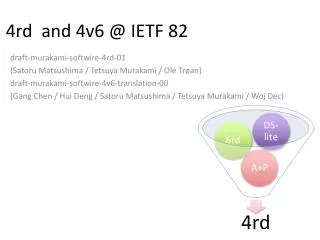
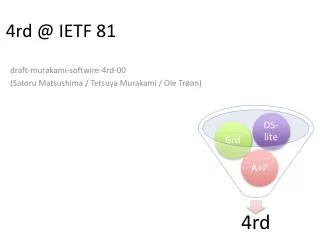
4rd @ IETF 81 draft-murakami-softwire-4rd-00 (Satoru Matsushima / Tetsuya Murakami / Ole Trøan)
Draft history Motivation draft: draft-operators-softwire-stateless-4v6-motivation-02 Applicability statement: draft-sun-intarea-4rd-applicability-01 DHCPv6 option: draft-mrugalski-dhc-dhcpv6-4rd-00
4rd in One Slide Subscriber IPv4 address or prefix derived from IPv6 address “One line” global config for IPv6 Gateway 4rd IPv4 + IPv6 IPv4 + IPv6 IPv4 + IPv6 • Native dual-stack IP service to the Subscriber • Simple, stateless, automatic IPv4-in-IPv6 encap and decap functions • IPv4 traffic automatically follows IPv6 Routing • BRs placed at IPv4 edge, addressed via anycast for load-balancing and resiliency • Defined in draft-murakami-softwire-4rd 4rd 4rd Dual Stack Core CE 4rd Border Relays 4rd IPv6
4RD : Stateless Address Mapping • Provisioning based on elements that are: • Well known • Derived from IPv6 provisioning • Provisioned via DHCPv6 • Embedded in address 48bit(IPv4 + Port) 32bit Port Set ID Domain IPv4 prefix EA-bits Port Head Port 0 0 0 1 0 0 1 0 1 1 Domain IPv6 prefix EA-bits Suffix Interface ID 128bit
IPv4 Address Sharing – Port-set ID deriving If there is a remainder of EA bits, this part will be treated as Port-set ID. IPv4 Internet CE IPv6 prefix (max 64bits) Domain IPv6 prefix EA bits 4rd BR CE 4rd prefix (33~47 bits) Domain IPv6Prefix: 2001:db8::/32 ISP’s IPv6 Network EA bits Domain 4rd prefix IPv4 shared address (32 bits) Port-set ID (max 15 bits) 4rd CE1 4rd CE3 4rd CE2 The Port-set ID is 8 bits, so 256 customers can share one IPv4 address of 192.0.2.205. CE IPv6Prefix: 2001:db8:cdab::/48 CE IPv6 Prefix: 2001:db8:cda1::/48 CE IPv6Prefix: 2001:db8:cdef::/48 Shared IPv4 Address: 192.0.2.205 Shared IPv4 Address: 192.0.2.205 Shared IPv4 Address: 192.0.2.205 Port-set ID: 0xab Port-set ID: 0xef Port-set ID: 0xa1 6
Next: • WG adoption