Support Vector Machines and Kernel Methods for Co-Reference Resolution
Support Vector Machines and Kernel Methods for Co-Reference Resolution. Alessandro Moschitti and Xiaofeng Yang. 2007 Summer Workshop on Human Language Technology Center for Language and Speech Processing John Hopkins University Baltimore, Agust 22, 2007. Outline. Motivations

Support Vector Machines and Kernel Methods for Co-Reference Resolution
E N D
Presentation Transcript
Support Vector Machines and Kernel Methods for Co-Reference Resolution Alessandro Moschitti and Xiaofeng Yang 2007 Summer Workshop on Human Language Technology Center for Language and Speech Processing John Hopkins University Baltimore, Agust 22, 2007
Outline • Motivations • Support Vector Machines • Kernel Methods • Polynomial Kernel • Sequence Kernels • Tree kernels • Kernels for Co-reference problem • An effective syntactic structure • Mention context via word sequences • Experiments • Conclusions
Motivations • Intra/Cross document coreference resolution require the definition of complex features, i.e. • syntactic/semantic structures • For pronoun resolution • Preference factors: Subject, Object, First-Mention, Definite NP • Constraint factors: C-commanding,… • For non-pronoun • Predicative Structure, Appositive Structure
Motivations (2) • How to represent such structures in the learning algorithm? • How to combine different features ? • How to select the relevant ones? • Kernel methods allows us to • represent structures in terms of substructures (high dimensional feature spaces) • define implicit and abstract feature spaces • Support Vector Machines “select” the relevant features • Automatic Feature engineering side-effect
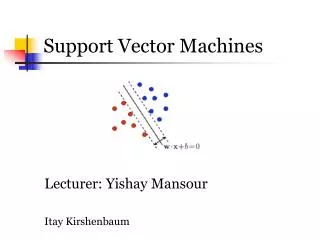
The margin is equal to We need to solve Support Vector Machines Var1 Var2
SVM Classification Function and the Kernel Trick • From the primal form
SVM Classification Function and the Kernel Trick • From the primal form • To the dual form where listhe number of training examples
SVM Classification Function and the Kernel Trick • From the primal form • To the dual form where listhe number of training examples
Flat features (Linear Kernel) • Documents in Information Retrieval are represented as word vectors • The dot product counts the number of features in common • This provides a sort of similarity
Feature Conjunction (polynomial Kernel) • The initial vectors are mapped in a higher space • Stock, Market,Downtown Stock, Market, Downtown, Stock+Market, Downtown+Market, Stock+Downtown • We can efficiently compute the scalar product as
String Kernel • Given two strings, the number of matches between their substrings is evaluated • E.g. Bank and Rank • B, a, n, k, Ba, Ban, Bank, Bk, an, ank, nk,.. • R, a , n , k, Ra, Ran, Rank, Rk, an, ank, nk,.. • String kernel over sentences and texts • Huge space but there are efficient algorithms
Word Sequence Kernel • String kernels where the symbols are words • e.g. “so BillGates says that” • Bill Gates says that • Gates says that • Bill says that • so Gates says that • so says that • …
VP VP V NP V NP VP VP D N V V NP NP D D N N delivers delivers a A Tree Kernel [Collins and Duffy, 2002] VP V NP D N delivers a talk
Explicit kernel space • Given another vector , • counts the number of common substructures
Implicit Representation • [Collins and Duffy, ACL 2002] evaluate in O(n2):
Kernels for Co-reference problem: Syntactic Information • Syntactic knowledge is important • For pronoun resolution • Subject, Object, First-Mention, Definite NP, C-commanding,…? • For non-pronoun • Predicative Structure, Appositive Structure … • Source of syntactic knowledge: Parse Tree: • How to utilize such knowledge…
Previous Works on Syntactic knowledge • Define a set of syntactic features extracted from parse trees • whether a candidate is a subject NP • whether a candidate is an object NP • whether a candidate is c-commanding the anaphor • …. • Limitations • Manually design a set of syntactic features • By linguistic intuition • Completeness, Effectiveness?
Incorporate structured syntactic knowledge – main idea • Use parse tree directly as a feature • Employ a tree kernel to compare the similarity of the tree features in two instances • Learn a SVM classifier
Syntactic Tree feature • Subtree that covers both anaphor and antecedent candidate syntactic relations between anaphor & candidate (subject, object, c-commanding, predicate structure) • Include the nodes in path between anaphor and candidate, as well as their first_level children • “the man in the room saw him” • inst(“the man”, “him”)
Context Sequence Feature • A word sequence representing the mention expression and its context • Create a sequence for a mention • “Even so, Bill Gates says that he just doesn’t understand our infatuation with thin client versions of Word ” • (so)(,) (Bill)(Gates)(says)(that)
Composite Kernel • different kernels for different features • Poly Kernel: for baseline flat features • Tree Kernel : for syntax trees • Sequence Kernel: for word sequences • A composite kernel for all kinds of features • Composite Kernel = TreeK*PolyK+PolyK+SeqenceK
Conclusions • SVMs and Kernel methods are powerful tools to design intra/cross doc coreference systems • SVMs allows for • better exploit attribute/vector features • the use of syntactic structures • the use of word sequence context • The results show noticeable improvement over the baseline