Download
1 / 17
170 likes | 206 Views
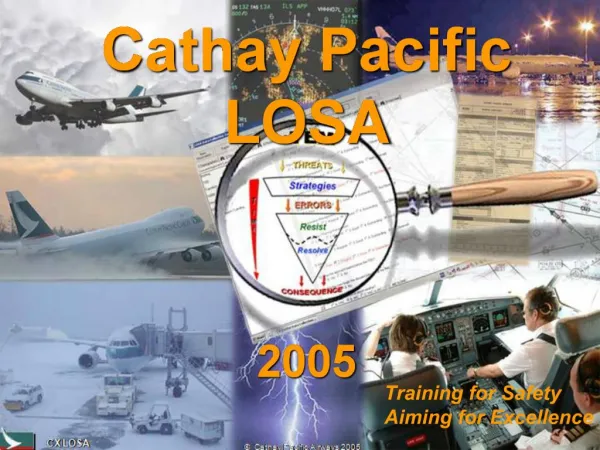
Cargo Services Head Office Cathay Pacific Cargo. Best Practices Adopted by Cathay Pacific on Cargo Safety (Loading Operations and Training). Corporate Safety Policy. Every individual within Cathay is responsible for “ensuring safety comes first” Our goal is zero accidents or injuries.

E N D
Cargo Services Head Office Cathay Pacific Cargo Best Practices Adopted by Cathay Pacific on Cargo Safety (Loading Operations and Training)
Corporate Safety Policy • Every individual within Cathay is responsible for “ensuring safety comes first” • Our goal is zero accidents or injuries. • We can achieve this goal by developing a culture where “ensuring safety comes first” forms the basis of all our activities.
At Cargo….. • When determine policy and procedure, adhere to; • Government and Authority, both Hong Kong and foreign countries • Industry best practice, primarily IATA • Company • Environment • Double check at critical control points • Training before performance of any operational duties • Establishing, measuring and reviewing appropriate safety performance goals and objectives, continually improving our safety performance • Ensuring open communication and timely feedback on safety issues to staff including ground handler
Training • Our policy • Training before performance of any operational duties • Training program includes: • Prepare ULD and build up • Dangerous goods - awareness and specialist • Special cargo including live animals, heavy and odd size cargo • Aircraft loading and load control • Ramp management • Aircraft loading, load control and ramp management require recurrent training in every 12 months • Dangerous Goods require recurrent training in every 24 months.
Quality System • Quality control • Pallet inspection • Bi-yearly quality control self check • Service audit • Perform manual load sheet practice on a quarterly basis for load control staff only • Safety reminder on a regular basis • Quality assurance • Consolidated port audit • Audit at head office level • Cargo quality assurance notice • IATA Operational Safety Audit (IOSA) • Management Review
We require double check at…. • Check weighing scales • Prepare ULD • Prepare dangerous goods and special cargo including odd size and heavy cargo • Weigh built ULD • Prepare dead load statement • Prepare aircraft loading • Secure the locks • Submit the final load
Who is going to deliver? • Cargo Services Head Office • Policy and procedure • Training • Quality Assurance • Cathay Cargo Office • Critical tasks and supervision • Ground Handler • Strictly adhere our policy and procedure • Cargo Agent and Shipper • Reach out program • Support from Regulator
What do we require from….. • Cargo terminal operator • Cathay cargo office • Ramp handling operator • Load control office • Ramp coordinator
Cargo terminal operator • Adhere to CX Cargo Services Manual, including • acceptance • build up • dangerous goods • special cargo including odd size and heavy cargo • ULD serviceability • Daily check on weighing scale and documented. • Calibrate weighing scale on a regular basis and documented. • Weigh built ULD twice before sending to plane.
Cathay cargo office • Upon receipt of any new revisions and/or instructions from Cargo Services Head office, distribute to the cargo terminal and ramp handling operator and ensure the manuals are updated. • Perform critical tasks, in particular safety related and supervision. • Regular performance review with cargo terminal and ramp handling operator and documented. • Develop and implement reach out program to cargo agents and shippers
Ramp handling operator • Staff member are trained and qualified in accordance with CX Aircraft Handling Manual. • All ground equipments stage in appropriate parking area with parking brakes applied prior to the arrival of aircraft at the parking bay. • Tail post or nose tether applied at any time prior loading or unloading activities commence. • Obtain “thumb up” signal from ground engineer and ULD condition check prior loading activity commence. • ULD loaded in accordance with Loading Instruction Form(LIF) and re-confirm with Load control office. • The restraint locks in all positions must be fully extended and checked prior closing L1 door. • Complete Loading Declaration Form to ensure the compliance of CX standards.
Load Control Office • Staff are trained and qualified in accordance with CX AHM. • Strictly adhere to CX Weight and Balance Folder. • Observe aircraft and the loading limitations including unoccupied positions, missing and/or damaged restraints. • Observe the fuel data, cargo loads and aircraft CG to obtain a safe trimming. • Complete load sheet check list as to ensure 100% data accuracy.
Ramp Coordinator • A designate trained and qualified staff to supervise overall cargo loading and unloading activities. • ULD condition check prior loading as to ensure there is no movement or collapse during transportation to plane side. • Special Cargo loaded and secured in according to CX AHM. • Restraint locks at all positions are fully extended including unoccupied positions. • To offload any sub-standard ULD as to avoid any possible damage to aircraft. • All documents, such as load plans, NOTOC are accurate and completed before submission to pilot • Complete Freighter Ramp Co-ordination Checklist to ensure the compliance of CX standards.