Download
1 / 6
60 likes | 164 Views
This document outlines the guiding principles of Finland's immigration policy, emphasizing two-way integration and the importance of fostering good relations between ethnic groups. It highlights the need for tailored measures to support immigrants, such as language education in Finnish and Swedish, and ensures equal treatment regardless of immigration reasons. The focus is on promoting immigrants' rights to their language and culture, improving recognition of qualifications, and enhancing educational resources for both immigrants and educators. The document advocates for increased availability of adult education and vocational training.

E N D
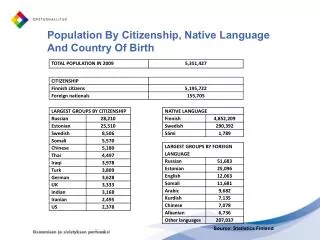
Population By Citizenship, Native Language And Country Of Birth Source: Statistics Finland
General principles guiding immigration policy of the Ministry of Education • Fostering good relation between different ethnic groups - two-way integration, measures targeted towards the original population • Taking into account the needs of immigrants within the functioning of regular services and systems - special targeted measures (special treatment, allocations) only as secondary options • Promoting the right of immigrants to their own language and culture • Equal treatment of immigrants regardless of the reasons for immigration • Efficient coordination of measures • Taking into account experiences of other countries
Guidelines in the field of education and research • Sufficient availability of Finnish/Swedish language teaching in all levels of education • Studies concerning multicultural issues for all teachers. More study places for teachers with immigrant background • Further development of recognition of knowledge • Efficient guidance and counselling services immediate availability, focus on periods of transition (from one education level to the next) • Strengthening of education on internationalism and tolerance • Promotion of mobility (students, teachers, researchers)
Adult education • Vocational basic or supplementary education • Upper secondary education • Liberal education (folk high schools, summer universities) • General language examination system a prerequisite for citizenship (64 providers of which 23 are folk high schools) • Education of illiterate adults cooperation between the Ministry of Education and the Ministry of Employment and the Economy • Training of teachers: an ESF-funded common model shared by 5 universities and 2 polytechnics
Adult education – targets (1) • To strengthen language teaching of immigrants • To develop the language examination system • To integrate language teaching into vocational, higher adult education and on-the-job training • To strengthen guidance and counselling services, and increase targeted services for immigrants having a higher education background
Adult education – targets (2) • To increase training for teachers with immigrant background or teachers working with immigrants • Transfers of administrative resources from the Min. of Employment and the Economy to the Min. of Education which concern teaching of illiterate adults • More resources for upper secondary education institutes • Changes in the legislation and funding of liberal adult education