Understanding Heredity: The Groundbreaking Work of Gregor Mendel
This overview explores the pioneering contributions of Gregor Mendel, often regarded as the "Father of Genetics." Born in 1822, Mendel's systematic studies on pea plants unveiled the principles of heredity and inheritance patterns. Through meticulous experimentation, he identified key traits governed by genes, proposed the Law of Segregation, and introduced fundamental concepts like dominant and recessive alleles. His work laid the foundation for modern genetics, revealing how traits are inherited and encouraging future exploration of genetic principles.

Understanding Heredity: The Groundbreaking Work of Gregor Mendel
E N D
Presentation Transcript
Understanding Heredity Part 1 1
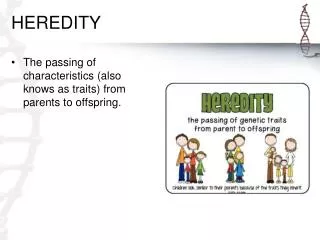
The Work of Gregor Mendel • ALL living things have a set of characteristics that are contained in genes. • These genes come from our parents and are found in every cell in our body. • Genetics – the scientific study of heredity
The Work of GregorMendel, cont. • Gregor Mendel – an Austrian Monk born in 1822 • He laid the foundation for much of our understanding of inheritance patterns • Credited as the “Father of Genetics”
The Work of Gregor Mendel, cont. • He was a mathematician/botanist and was in charge of the monastery garden • He noticed that individual plants of the same species were not identical
The Work of Gregor Mendel, cont. • He wanted to know why they were not identical, so he experimented on pea plants to help answer the question.
The Work of Gregor Mendel, cont. • He selected seven traits found in pea plants to study: • Seed shape • Seed color • Pod shape • Pod color • Plant height • Flower color • Flower position
The Work of Gregor Mendel, cont. Why pea plants? • Pea plants are pure breeding – they produce identical offspring when they self-pollinate • They grow fast • They have traits in distinct alternate forms (either/or)
The Work of Gregor Mendel, cont. • These characteristics allowed Mendel to control the outcome when he cross-pollinated plants with contrasting traits • The resulting offspring are called a monohybrid cross
The Work of Gregor Mendel, cont. How did he make these monohybrid crosses? • Mendel prevented self-pollination in the plants by removing the stamen • He dusted the pollen from one stamen onto another plant’s pistil (cross polination) • The result: cross-breed plants
The Work of Gregor Mendel, cont. What happened next? • He called the original plants the Parent (P) generation • The offspring produced by the P generation were the F1 generation; also called hybrids
The Work of Gregor Mendel, cont. • All of the hybrids showed the traits of only one of their parents… • The traits from the other parent had disappeared!
The Work of Gregor Mendel, cont. Where did those traits go? • To answer that question, Mendel let the F1 plants self-pollinate • This produced the F2 generation: ~ ¾ of the plants showed the traits of their parents (the F1 generation) ~ ¼ of the plants showed the traits of their grandparents (the P generation)
The Work of Gregor Mendel, cont. • This lead Mendel to make two conclusions about what he called biological inheritance (we call it genes): • Traits are passed from one generation to the next • Each trait is found in at least 2 contrasting forms
The Work of Gregor Mendel, cont. • He further concluded that: • Traits are inherited as distinct units from the parent • Organisms inherit 2 copies of each unit (one per parent) • Organisms donate one of those copies when they make gametes • The 2 copies separate (segregate) during gamete formation • These conclusions became know as the Law of Segregation
Modern Genetics • Some traits are dominant over other traits • The unit that seems to disappear is recessive – it can only be expressed when 2 recessive traits combine
Modern Genetics, cont. • We refer to traits as genes • Genes are sections of chromosomes • Each form of the gene is called an allele • An organism can be: Homozygous – having 2 identical alleles OR Heterozygous – having 2 different alleles
Modern Genetics, cont. • Phenotype – the physical characteristics of the organism (what it looks like) • Genotype – the genetic makeup of the organism (what is actually there) The phenotype of an organism is the result of: • The Genotype • Environmental pressures
Probabilities • Mendel realized that the Principle of Probability (the likeliness that a particular event will occur) could be used to predict and explain the results of genetic crosses. • If there are 2 possible outcomes, then there is a 1 in 2 or 50% chance of each outcome occurring.
Probabilities, cont. • Example: If you flip a coin 3 times in a row, what are the chances it will be heads up every time? ½ x ½ x ½ = 1/8 • Probabilities can predict the average outcome of a large number of events – not the outcome of an individual event. • For that, we need Punnett Squares…
Punnett Squares • The gene combination that might result from a genetic cross can be predicted and compared with a Punnett Square • The dominant allele is represented by a capital letter (like T for tall) • The recessive allele is represented by a lower case letter for the same trait (like t for short)
Punnett Squares, cont. • Monohybrid cross - cross involving a single trait ex. flower color • Dihybrid cross - cross involving two traits ex. flower color & plant height
Non-mendelian genetics Beyond Dominant & Recessive Alleles
Beyond Dominant & Recessive Alleles • Principle of Independent Assortment: genes for different traits can segregate independently during the formation of gametes • This accounts for the genetic variations among organisms of the same species!
Beyond Dominant & Recessive Alleles, cont. • The majority of genes have more than two alleles • Many traits are controlled by more than one gene • Most of the genes that affect the physical appearance of an organism are found on the autosomes
Beyond Dominant & Recessive Alleles, cont. 1. Incomplete dominance – case where one allele is not completely dominant over another; produces an intermediate type
Beyond Dominant & Recessive Alleles, cont. 2. Codominance – both alleles contribute to the phenotype; it is a blend of the two alleles
Beyond Dominant & Recessive Alleles, cont. 3. Multiple Alleles – one individual can only have two alleles but more than two alleles can exist in a population.
Beyond Dominant & Recessive Alleles, cont. 4. Polygenic traits – many traits are produced by the interaction of several genes Examples: hair, eye and skin color
Beyond Dominant & Recessive Alleles, cont. 5. The characteristics of an organism are also determined by the environment it lives in