Advanced Cognitive Psychology
190 likes | 577 Views
Advanced Cognitive Psychology. Lecture 1. Cognitive Psychology. “Cognitive Psychology refers to all processes by which sensory input is transformed, reduced, elaborated, stored, recovered, and used.”. Cognitive Psychology.


Advanced Cognitive Psychology
E N D
Presentation Transcript
Advanced Cognitive Psychology Lecture 1
Cognitive Psychology • “Cognitive Psychology refers to all processes by which sensory input is transformed, reduced, elaborated, stored, recovered, and used.”
Cognitive Psychology • “The experimental study of human information processing in its many manifestations.” • Experimental study: Based on the experimental method, empirical, scientific. • Human information processing: People sometimes operate as information processors. • Many manifestations: Information comes from the environment, is stored briefly, some is selected for additional processing, something is done to it, it may result in some additional behavior.
Paradigm • Intellectual antecedents • Pretheoretical ideas • Subject matter • Analogies • Concepts and language • Methodology
Intellectual Antecedents • Experimental • Structuralists • Behaviorists • Verbal learners • Human engineering • Information processing • Mental chronometry • Information
MST PPL CN RD THS SNTNC • The witness was examined by the ___.
Intellectual Antecedents • Linguistics • Synthesis
Pretheoretical Ideas • Symbol manipulation • Representation • Innateness • Processing takes time
Subject Matter • Table of contents
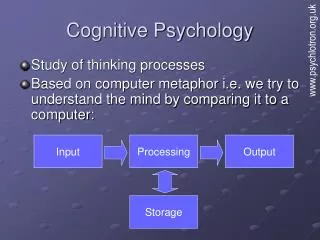
Analogies • Information processing devices • Computer metaphor
Concepts and Language • In a minute…
Methodology • Convergent techniques • Computer simulation • Reaction time • Stroop • “John pounded in the nail.” • Naming • Lexical decision • Item recognition
2 X 3 • 4 X 5 • 5 X 2 • 3 X 4 • 4 X 3 • 2 X 5 • 3 X 2
6 X 9 • 9 X 7 • 8 X 8 • 7 X 6 • 7 X 9 • 8 X 7 • 9 X 8
Sensory Store Filter Pattern Recognition Selection STM LTM Input (Environment) Response Architecture • See the box model.
Architecture • Three stages: • Input • Processing • Output
The Middle Part • Representation • Physical symbol system • Storage • Propositions • Images • Processes • Working memory
The Middle Part • Process • Goal satisfaction • Image manipulation • Automatization • Interpretation • Memory