Dred Scott
Dred Scott. Background. Scott was the slave of an Army surgeon who took him from Missouri to posts in Illinois and modern day Minnesota. Scott’s owner died and the man’s widow inherited him
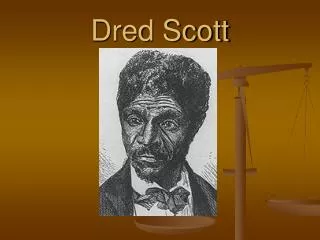

Dred Scott
E N D
Presentation Transcript
Background • Scott was the slave of an Army surgeon who took him from Missouri to posts in Illinois and modern day Minnesota. • Scott’s owner died and the man’s widow inherited him • White friends of Scott advised him in 1846 to sue for his freedom on grounds of prolonged residence in a free state and a free territory
Supreme Court • When Scott’s owner moved (with him) to New York his lawyers took the case to federal courts citing the diverse-citizenship clause of the Constitution. • Gives federal courts jurisdiction over cases involving citizens of different states. • 1854: Federal circuit court for Missouri takes Scott’s case
Major questions before the court • As a black man, was Scott a citizen with a right to sue in federal courts? • Had prolonged residence (two yrs. in each place) in a free state & territory made Scott free? • Was Fort Snelling actually a free territory? (Did congress have the right in 1820 to ban slavery in the Louisiana Purchase north of the 36-30?
The Ruling (1857) • The Supreme Court’s southern majority ruled against Scott.
Why? • The court initially was prepared to avoid questions 1 & 3 by upholding precedent set by earlier courts, which deferred to state law. • Instead the court decided to rule more thoroughly on all aspects of the case. • Northern judges would not go along w/ the less thorough decision – this would give the appearance of geographically divided court. (not good)
Why? Chief Justice Roger B. Taney’s Majority Opinion • Question 1: • Negroes had not been a part of the “sovereign people” who made the Constitution; they were not included in the “all men” whom the Declaration of Independence proclaimed “created equal.” • Negroes “had for more than a century before been regarded as beings of an inferior order . . . So far inferior, that they had no rights which a white man was bound to respect.” R.B. Taney
Question 1 cont. • Dissenting opinion (Curtis & McLean) • Free blacks in 1788 and beyond had several legal rights: • Hold and bequeath property • Make contracts • Seek redress in courts • Five of thirteen states that ratified the Constitution allowed black men to vote and they participated in the ratification process.
Question 2 (Taney) • Dred Scott’s time in Illinois and Fort Snelling did not make him free upon returning to Missouri. • Curtis & McLean dissented
Question 3 (Taney) • Congress had never had the right to prohibit slavery in the territories. • Article IV sec. 3 of the Constitution did not apply because “needful rules and regulations” are not laws. • The 5th Amendment protects life, liberty, and property. Slavery was not different from any other property, therefore a ban on slavery was unconstitutional.
Question 3 (Curtis & McLean) • Scott was a free man by virtue of his extended stays in free territory • Scott was also a citizen under the Constitution • The Constitution did empower Congress to prohibit slavery in territories. “All needful rules and regulations” meant exactly what it said. • The first Congress upheld the 1787 Northwest Ordinance banning slavery in the Northwest Territory. Many examples pre-1820 • Became the Republican viewpoint on slavery
Effects • Southerners thought it would crush the anti-slavery movement because slavery was now the supreme law of the land • “Black Republicanism is dead” • Politicized the issue of slavery even more • Republican Party effectively used the court decision as a propaganda tool • The Republican party gained support and momentum • Lincoln elected president in next election - 1860