Understanding Equilibrium Constants and Calculations in Chemical Reactions
70 likes | 206 Views
This guide explores the concept of the equilibrium constant (K) and its significance in chemical reactions. We provide detailed examples on writing equilibrium expressions and calculating concentrations at equilibrium, including the reactions of carbon monoxide and hydrogen, as well as ammonia decomposition. Practical exercises are included to reinforce learning and application of these concepts. Familiarity with the equilibrium expression helps predict reactant and product concentrations in a chemical system.


Understanding Equilibrium Constants and Calculations in Chemical Reactions
E N D
Presentation Transcript
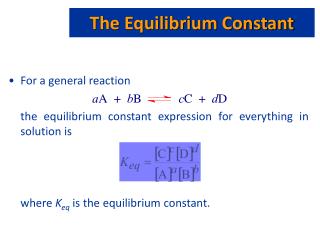
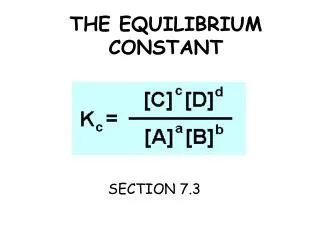
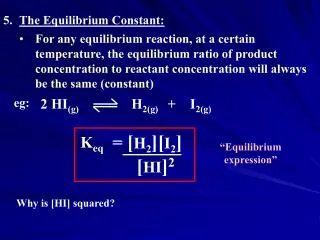
Example 1 Given: CO + 2H2⇌ CH3OH Write an appropriate equilibrium expression.
Example 2 If [H2] and [F2] start out at 1.00mol/L and [HF] = 0mol/L, find [H2] and [HF] at equilibrium if [F2] at equilibrium is 0.240 mol/L. H2 + F2⇌ 2HF
Practice Given: [NH3] = 2.0mol/L initially and [NH3] = 1.0mol/L at equilibrium, determine the concentrations of N2 and H2 at equilibrium. NH3⇌ N2 + 3H2
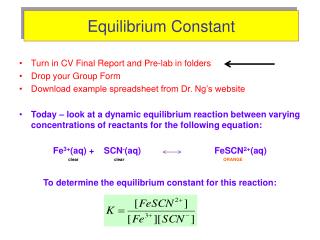
The Magnitude of K The value of K helps to predict the relative concentrations of reactants and products in an equilibrium system.
Homework • Read P. 431-440, 447-448 • P. 437 #6,7 • P. 437 #3,4,7,8 • P. 442 #1 • P. 444 #3-6