Download
1 / 12
120 likes | 258 Views
Family caregivers provide vital unpaid support to individuals with chronic illnesses or disabilities. Nearly one-third of U.S. adults, about 65.7 million people, serve as family caregivers, undertaking tasks that range from daily activities to complex medical procedures. These caregivers experience significant stress, leading to increased risks of chronic diseases, depression, and premature aging. Challenges faced include complex medical devices and insufficient training. An online repository of medical devices could alleviate some of these stressors, ensuring better outcomes for caregivers and their loved ones.

E N D
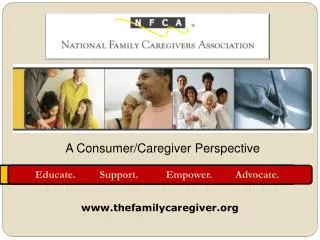
A Consumer/Caregiver Perspective Educate. Support. Empower. Advocate. www.thefamilycaregiver.org
Who are family caregivers? People who provide essential “unpaid” assistance to someone with a chronic illness and/or disability “family” describes a special relationship with the care recipient, based on birth, adoption, marriage, or declared commitment “caregiver” is a job description that can include providing personal care, carrying out medical procedures, managing a household, and interacting with the formal healthcare and social service systems on another’s behalf
family caregivers? Who are Nearly one-third of the U.S. adult population: 65.7 million people Source: Caregiving in the US. Conducted by the National Alliance for Caregiving, in partnership with AARP, funded by MetLife Foundation. Released 12/9/2009. Not yet in publication. Available at www.Caregiving.org.
What do family caregivers do? • Activities of Daily Living • Transfers • Getting in and out of beds and chairs • Getting dressed • Bathing/Showering • Getting to and from the toilet • Feeding • Dealing with incontinence/diapers
What do family caregivers do? • Medical procedures • Wound care • Trach Care • Catheterization • Injections • Medication Management • Taking and reporting vital signs • Gathering and reporting diabetes #s
What do family caregivers do? • Care Coordination • Communicating with Healthcare providers • Appointment management • Scheduling coordination • Managing transitions of care • Discharge planning
What do family caregivers do? • Instrumental Activities of Daily Living • Transportation (providing and/or arranging) • Housework • Grocery Shopping • Preparing meals • Managing Finances • Giving medications, pills, injections • Arranging or supervising paid support services • Navigating insurance
How does this impact family caregivers? stress Stress of family caregiving for persons with dementia has been shown to impact a person's immune system for up to three years after their caregiving ends thus increasing their chances of developing a chronic illness themselves. depression • Family caregivers who provide care 36 or more hours weekly are more likely than non-caregivers to experience symptoms of depression or anxiety. For spouses the rate is six times higher; for those caring for a parent the rate is twice as high. chronic disease • Family caregivers report having a chronic condition at more than twice the rate of non-caregivers.
How does this impact family caregivers? premature aging • Family caregivers experiencing extreme stress have been shown to age prematurely. This level of stress can take as much as 10 years off a family caregiver's life. increased risk of mortality A wife's hospitalization increases her husband's chances of dying within a month by 35%. A husband's hospitalization boosts his wife's mortality risk by 44%.
What device challenges do family caregivers face? • Devices too complex for family caregiver use, even with initial training • Device instructions/manuals not written for family caregiver audience • Instruction provided during stressful transitions of care • Device labeling often includes confusing and difficult-to-comprehend warnings, precautions, and contraindications. • Device may not be compatible with family caregiver’s capabilities, lifestyle or environment. • Device delivered not always the same make or model that prescriber described. • Pets, children, home environment • Device maintenance may take place in a setting or time significantly remote from initial instruction.
How could an on-line repository of medical devices impact family caregivers and their loved ones? • Reduce caregiver stress • Potential to reduce adverse outcomes • Potential to improve patient outcomes • Improve consumer relations • Demonstrate commitment of industry and government to make sure the patient is as healthy and has as high a quality of life as possible