Download
1 / 6
60 likes | 193 Views
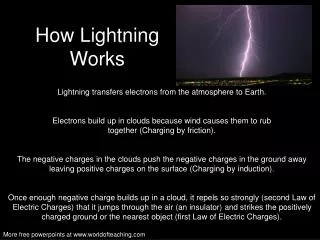
Lightning is a fascinating phenomenon that involves the transfer of electrons from clouds to the ground. As wind causes electrons to rub together, they accumulate in clouds, leading to a buildup of negative charge. This negative charge repels other negative charges on the ground, leaving a positive charge on the surface. When the charge difference becomes significant, the negative charge jumps to the positively charged ground or nearby objects. Lightning rods can protect buildings by directing lightning safely into the ground through a metal conductor.

E N D
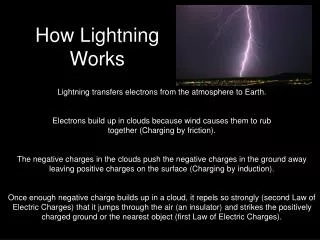
How Lightning Works Lightning transfers electrons from the atmosphere to Earth. Electrons build up in clouds because wind causes them to rub together (Charging by friction). The negative charges in the clouds push the negative charges in the ground away leaving positive charges on the surface (Charging by induction). Once enough negative charge builds up in a cloud, it repels so strongly (second Law of Electric Charges) that it jumps through the air (an insulator) and strikes the positively charged ground or the nearest object (first Law of Electric Charges).
Lightning Rods This figure shows how a lightning rod can protect a house from a lightning strike. A metal rod is attached to the highest part of the building. A conductor is connected from the metal rod to a metal plate in the ground. If lightning strikes the rod, the conductor carries the negative charges safely into the ground.