Enhancing DNA Sequence Alignment Through GPU Optimization for Irregular Computations
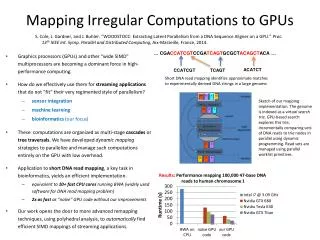
The paper presents WOODSTOCC, a system for extracting latent parallelism from DNA sequence aligners running on GPUs. The authors address the challenge of effectively utilizing GPUs for streaming applications that do not conform to standard parallelism models. They propose dynamic mapping strategies to manage multi-stage cascade computations with low overhead, specifically focusing on short DNA read mapping in bioinformatics. The implementation demonstrates significant performance improvements, achieving over 10 times the speed of traditional CPU processing and double the speed of naïve GPU implementations, paving the way for more advanced computational techniques.

Enhancing DNA Sequence Alignment Through GPU Optimization for Irregular Computations
E N D
Presentation Transcript
Mapping Irregular Computations to GPUs S. Cole, J. Gardner, and J. Buhler. “WOODSTOCC: Extracting Latent Parallelism from a DNA Sequence Aligner on a GPU.” Proc. 13th IEEE Int. Symp. Parallel and Distributed Computing, Aix-Marseille, France, 2014. … CGACCATCGTCCGATCAGTGCGCTACAGCTACA … • Graphics processors (GPUs) and other “wide SIMD” multiprocessors are becoming a dominant force in high-performance computing. • How do we effectively use them for streaming applications that do not “fit” their very regimented style of parallelism? • sensor integration • machine learning • bioinformatics (our focus) • These computations are organized as multi-stage cascades or treetraversals. We have developed dynamic mappingstrategies to parallelize and manage such computations entirely on the GPU with low overhead. • Application to short DNA read mapping, a key task in bioinformatics, yields an efficient implementation. • equivalent to 10+ fast CPU cores running BWA (widely used software for DNA read mapping problem) • 2x as fast as “naïve” GPU code without our improvements • Our work opens the door to more advanced remapping techniques, using polyhedral analysis, to automatically find efficient SIMD mappings of streaming applications. ACATCT CCATCGT TCAGT Short DNA read mapping identifies approximate matches to experimentally derived DNA strings in a large genome. Sketch of our mapping implementation. The genome is indexed as a virtual search trie. GPU-based search explores this trie, incrementally comparing sets of DNA reads to trie nodes in parallel using dynamic programming. Read sets are managed using parallel worklist primitives.