Advancements in Hydrologic Ensemble Forecasting: A Post-Processor Approach
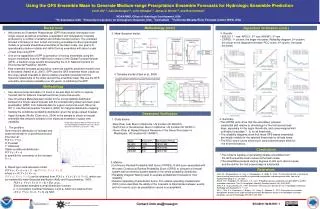
This presentation discusses the development of a post-processor for hydrologic ensemble forecasts, offering insights into its application and calibration using data from various river basins. Key components include assessment of uncertainty, verification of ensemble predictions, and data assimilation methods. The results highlight the effectiveness of ensemble mean predictions in comparison to observed data, emphasizing the importance of adjusting inflow and outflow estimates for improved forecasting accuracy. Methodological challenges and future directions for enhancing ensemble forecasting capabilities are also addressed.

Advancements in Hydrologic Ensemble Forecasting: A Post-Processor Approach
E N D
Presentation Transcript
A Post-Processor for Hydrologic Ensemble Forecasts John Schaake,1 Robert Hartman,2James Brown,1 D.J. Seo1, and Satish Regonda1 1. NOAA/NWS Office of Hydrologic Development 2. NOAA/NWS California-Nevada River Forecast Center Presentation to European Geosciences Union April 17, 2008 Vienna
Elements of a Hydrologic Ensemble Prediction System Ensemble Verification System QPE, QTE, Soil Moisture QPF, QTF Ensemble Pre-Processor Parametric Uncertainty Processor Data Assimilator Hydrology & Water Resources Models Streamflow Ensemble Post-Processor Hydrology & Water Resources Ensemble Product Generator Ensemble Product Post-Processor Fig 1
CNRFC Ensemble Prototype Smith River Mad River Salmon River Van Duzen River American River (11 basins) Navarro River
NFDC1 – March 15 30-day Post-Processor Calibration Analysis of Historical Model Simulation Results
NFDC1 – March 1530-day GFS-Based Hydrologic Ensemble Forecasts Ensemble Mean vs Observed Cumulative Rank Histograms
NFDC1 – March 15 ForecastsCumulative Rank Histograms for Different Forecast Products
LAMC1(Lake Mendocino, CA) Russian River Basin
Russian River • Total Area 3465 km2. • Elevation 17m - 1245m. • 2 Flood Control Reservoirs • 3 Local Areas. • 3 Official Flood Forecast Points. • Floods Nearly Every Year. • 3 Major Floods in Past 40 Years.
LAMC1 – Schematic of Possible Post Processor Applications Diversion from Eel Basin Estimated Natural Flow Gaged Outflow COE Estimated Inflow Basin Model Of Natural Flow Post-Processor To Adjust to Observed Inflow Reservoir Operations Model Post-Processor To Adjust to Observed Outflow
Full Natural Flow – March 15 Analysis of Historical Model Simulation Results
Full Natural Flow to Inflow – March 15 Analysis of Historical Model Simulation Results
Climatologies of Measured Inflow and Modeled Natural Flow (December – June)
Full Natural Inflow to Resevoir Outflow - March 15 Analysis of Historical Model Simulation Results
GLDA3(Lake Powell Inflow) EPG Post-Processor Calibration Results
June Calibration – Lake Powell Analysis of Historical Model Simulation Results
July Calibration – Lake Powell Analysis of Historical Model Simulation Results
Some Challenges • Alternative ways to evaluate Post-Processor integral equation to relax bivariate normality assumption that I used to get started? • Can we adjust individual ESP traces (preserving temporal scale-dependent uncertainty) by using a cascade approach to apply multiple window applications of the product-based postprocessor? • Multi-model applications?


![[Post Processor]](https://cdn2.slideserve.com/5127715/slide1-dt.jpg)