The War in the Pacific
190 likes | 315 Views
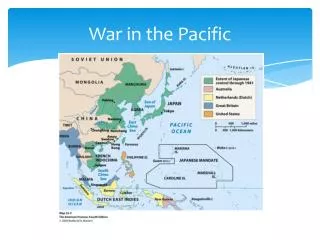
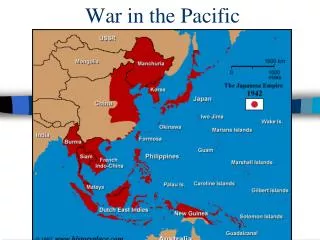
The War in the Pacific. Americans could not celebrate V-E Day for long The war was still on in the Pacific Japan had conquered much of southeast Asia Hong Kong, French Indochina, Thailand, much of mainland China, Dutch East Indies


The War in the Pacific
E N D
Presentation Transcript
Americans could not celebrate V-E Day for long • The war was still on in the Pacific • Japan had conquered much of southeast Asia • Hong Kong, French Indochina, Thailand, much of mainland China, Dutch East Indies • Japanese tried to capture the Philippines, but met resistance from the Americans and General MacArthur • MacArthur evacuated to Australia; General Wainwright surrendered on May 8, 1942
Doolittle’s Raid • Air raid on Japan launched from the aircraft carrier Hornet • Based on theory that a plane could be launched from an aircraft carrier • Most of the planes bombed Tokyo, but the damage was modest
Battle of the Coral Sea • The main Allied forces in the Pacific were Americans and Australians • In May 1942, they succeeded in stopping the Japanese drive toward Australia in the 5 day Battle of the Coral Sea
Battle of Midway • Japan’s next move was toward Midway Island • Strategic island northwest of Hawaii • Admiral Chester Nimitz moved to defend the island • America won a decisive victory as their planes destroyed 4 Japanese aircraft carriers and 250 planes • Battle of Midway was a turning point • Soon the Allies were island hopping toward Japan
Kamikaze Pilots Attack Allies • Japanese countered Allied advances with a new tactic • Kamikaze, which means divine wind, attacks were suicide attacks by Japanese pilots
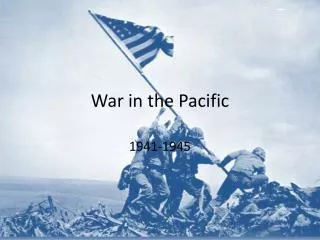
Iwo Jima • General MacArthur and the Allies next turned to the island of Iwo Jima • The island was critical as a base for an attack on Japan • It was called the most heavily defended spot on earth • Allied and Japanese forces suffered heavy casualties • Allies achieved victory in March 1945
Iwo Jima
Okinawa • In April 1945, U.S. Marines invaded Okinawa • The Japanese unleashed 1,900 kamikaze attacks • Sunk 30 ships and killed 5,000 sailors • Okinawa cost the Americans 7,600 Marines and the Japanese 110,000 soldiers
Manhattan Project • After Okinawa, MacArthur predicted that a Normandy type amphibious invasion of Japan would result in 1.5 million Allied deaths • President Truman saw only one way to avoid an invasion of Japan… • Truman decided to use a powerful new weapon—the atomic bomb • Developed by scientists like J. Robert Oppenheimer
Hiroshima and Nagasaki • Truman warned Japan in July 1945 that without an immediate surrender, it faced “prompt and utter destruction” • This was called the Potsdam Ultimatum • Atomic bombs were dropped in early August 1945 • Hiroshima—August 6; Nagasaki—August 9 • Japan surrendered on August 14, 1945 • This is known as V-J Day
Yalta Conference • In Feb. 1945, an ailing FDR met with Churchill and Stalin at Yalta in the USSR • A series of compromises were worked out concerning post-war Europe • Germany would be divided into 4 occupied zones • Stalin agreed to free elections in Eastern Europe • Stalin agreed to help in the war against Japan and to join the United Nations
Winston Churchill, Franklin Roosevelt, and Joseph Stalin at Yalta in February 1945
Nuremberg War Trials • The discovery of Hitler’s death camps led the Allies to put 24 Nazi leaders on trial • Tried for crimes against humanity, crimes against the peace, and war crimes
Occupation of Japan • Japan was occupied for 7 years by U.S. forces under General MacArthur • He reshaped Japan’s economy by introducing free-market practices that led to remarkable economic recovery • Also introduced a liberal constitution known as the MacArthur Constitution