Understanding Cloud Computing: Evolution, Advantages, and Landscape
Cloud computing has revolutionized how organizations manage and utilize IT resources. Evolving from grid computing in the 1990s, it offers on-demand resource provisioning, enabling scalability and cost reduction. Key players like Google, IBM, and Amazon dominate the market, offering public, private, and hybrid cloud services. Businesses can access computing, storage, and software seamlessly while avoiding unnecessary hardware investments. Applications span across social networking, email, document hosting, and healthcare, making cloud computing an integral part of modern business operations.

Understanding Cloud Computing: Evolution, Advantages, and Landscape
E N D
Presentation Transcript
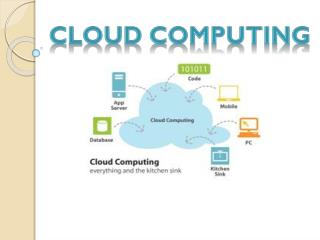
Cloud Computing • new buzz word • driven largely by marketing and service offerings • Provided by big corporate players • Google • IBM • Amazon • Apple
History • 1990’s • Development of “the grid” by connecting machines together to create a massive, shared pool of storage and computing power. • Used resources to create on that would be much larger than what any one institution could afford to build.
Grid Computing • Required the use of software that can divide and farm out pieces of a program as one large system to several thousand computers. • Problem • If one piece of the software node fails, other pieces of the software on other nodes may fail. • Large system images and associated hardware to operate and maintain could contribute to large capital & operating expenses.
Cloud Computing • Evolved from grid computing & provides on-demand resource provisioning.
Grid vs. Cloud • Grid – Large job is divided into many small portions and executed on multiple machines. • Cloud -Intended to include delivery of software, infrastructure, and storage over the Internet based on the user’s demand.
Advantages • On demand Service • Customer simply requests and amount of computing, storage, software, process or other resources from the service provider. • Elasticity • Provides the ability to scale up & down • when additional users are added • When application requirements change. • Cost Reduction • By purchasing just the right amount of IT resources on demand the organization can avoid purchasing unnecessary equipment. • Application Programming Interfaces • Accessibility to software that enables machines to interact with cloud software .
Landscape of Cloud Computing • Public Cloud • Resources offered as a service & shared across multiple organizations, managed by an external service provider. • Private Cloud • Resources dedicated to a single organization and offered on demand. • Hybrid Cloud • Mix of private and public clouds managed a single entity to extend capacity across clouds as needed.
Examples - • Social Networking • Facebook, Linkedin, MySpace, Twitter • Email • Hotmail, Windows Live Mail, • Document/Spreadsheet/Other hosting • Google Drive, SkyDrive, Zoho Office, Flickr, Onit, YouTube • Backup Services • JungleDisk, Carbonite, Syncplicity, Dropbox. • Banking and Financial Services • Storing of Banking and Tax Records and Information • Health Care • Electronic Health Record (HER), Google Health, Microsoft HealthVault