Download
1 / 1
10 likes | 125 Views
Innovative Dynamics, Inc. in Ithaca, NY has developed a groundbreaking smart coating system for in-situ monitoring of turbine engine components. This technology employs a crackwire sensor that can detect incipient cracks through microwave interactions. Achievements include a non-destructive inspection method and a non-contact sensing technique tested on simulated engine parts. The Navy estimates savings of $1 billion on disk servicing, and engine manufacturers show interest for use during development and in-service operations. Participation in FAA-sponsored tests signals strong commercialization potential.

E N D
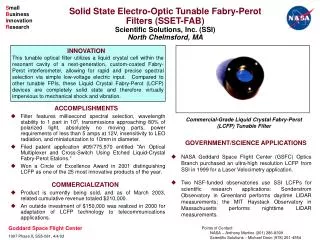
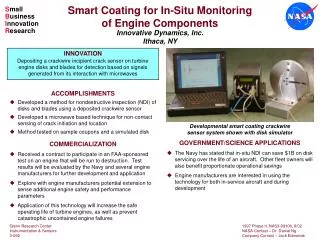
Smart Coating for In-Situ Monitoring of Engine Components Small Business Innovation Research Innovative Dynamics, Inc. Ithaca, NY INNOVATION Depositing a crackwire incipient crack sensor on turbine engine disks and blades for detection based on signals generated from its interaction with microwaves • ACCOMPLISHMENTS • Developed a method for nondestructive inspection (NDI) of disks and blades using a deposited crackwire sensor • Developed a microwave based technique for non-contact sensing of crack initiation and location • Method tested on sample coupons and a simulated disk Developmental smart coating crackwire sensor system shown with disk simulator • GOVERNMENT/SCIENCE APPLICATIONS • The Navy has stated that in-situ NDI can save $1B on disk servicing over the life of an aircraft. Other fleet owners will also benefit proportionate operational savings • Engine manufacturers are interested in using the technology for both in-service aircraft and during development • COMMERCIALIZATION • Received a contract to participate in an FAA-sponsored test on an engine that will be run to destruction. Test results will be evaluated by the Navy and several engine manufacturers for further development and application • Explore with engine manufacturers potential extension to sense additional engine safety and performance parameters • Application of this technology will increase the safe operating life of turbine engines, as well as prevent catastrophic uncontained engine failures Glenn Research Center Instrumentation & Sensors 3-092 1997 Phase II, NAS3-99106, 8/02 NASA Contact – Dr. Daniel Ng Company Contact – Jack Edmonds