Download
1 / 39
400 likes | 517 Views
This document highlights key management practices essential for successful corn and soybean farming. It discusses the importance of paying attention to details, such as soil health and nitrogen application rates. The guidelines provided include recommendations for nitrogen fertilizers, emphasizing the timing and placement to optimize yield. Additionally, the report addresses weed control strategies and the necessity of rotating herbicides to combat resistance. It also outlines common soybean diseases, offering insights into maintaining healthy crops for maximum profitability.

E N D
Corn and Soybean Management Issues Riverland Community CollegeDecember 6, 2006 Lynn Lagerstedt
What Makes a Person a Successful Farmer? • Paying attention to detail
One Observation Many fields with headlands stronger than the field. Why?
Guidelines for use of Nitrogen-Fertilizer (Corn) • University of Minnesota Nitrogen Suggestions
Impact of Reducing Rates of Spring-applied Nitrogen Information from the Iowa Soybean Association • Corn producers at 143 sites compared normal rate of Nitrogen to 50 lb N/acre less in replicated two-treatment precision farming trials that covered at least 20 acres • Fertilizer N usually was applied shortly before or after planting • All fields were corn following soybeans
Nitrogen Rate Guidelines • FORM: • Commercial nitrogen source at discretion of producer • All nitrogen sources (ex. MAP, DAP, liquid starters, etc.) must be accounted for in final nitrogen application rates • Anhydrous ammonia only for fall applications Guidelines for Minnesota Nutrient Management Initiative
Nitrogen Rate Guidelines • TIMING AND PLACEMENT: • A farm can have a fall-applied site, a spring-applied site, or split application site but not in combination within the same site. Timing will be held constant across a site relative to season of application. • Fall AA applications will be delayed until the soil temperature remains below 50° F at 6-inch depth Guidelines for Minnesota Nutrient Management Initiative
Nitrogen Rate Guidelines • TIMING AND PLACEMENT (cont): • Use a nitrification inhibitor with fall and pre-plant nitrogen applications if soils poorly drained and soil moisture levels are high near the surface • Side-dress application before corn reaches a 12 inch height • If split applications – one of the applications must be of equal rate over entire demonstration site • Spring pre-plant Urea and/or UAN applications incorporated within 3 days on NRCS strips Guidelines for Minnesota Nutrient Management Initiative
N Treatment lb/Acre 0 30 60 90 120 150 180 30+60* LSD (0.10) Corn Yield Bu/Acre 135.2 155.3 186.0 194.8 199.6 204.5 206.5 185.8 12.7 Nitrogen Trial • Conducted by the University of Minnesota in Fillmore County *30 lb N/A preplant as urea plus 60 lb N/A sidedressed with UAN at V6 stage
Nitrogen Observations • High organic matter soils • Nitrogen as Anhydrous Ammonia Spring pre-plant or sidedress produced good results with 100 lbs actual Nitrogen • Urea at 100lbs N/acre resulted in N deficiency • Low organic matter soils • Anhydrous Ammonia at 100 lbs/acre resulted in N deficiency
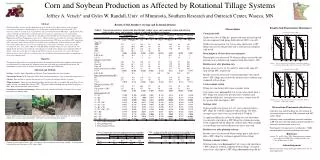
"K-Profile" Fertility Stratification History of Moldboard Plow
"K-Profile" Fertility Stratification
Aerial Image and Potassium Test
Weed Control • Weed resistance to herbicides • Weed adaptation • Shift in weed species How important is it to rotate herbicides?
Weed Control Corn weed control programs that work • Woolly Cupgrass • Reduced rate of soil-applied grass herbicide followed by a reduced rate of Accent/Steadfast
Weed Control Corn weed control programs that work • Giant Ragweed • 2,4-D at a low rate when corn is spike to 2-leaf, followed by a planned broadleaf herbicide
Weed Control Soybeans • Soil applied herbicide followed by post-emergence herbicide • DNA (Treflan, Prowl) • Boundary (Dual, Sencor) • Authority • Is it available?
Soybean Diseases • Phytophthora Root Rot • Soybean Cyst Nematode • Anthracnose • Brown Stem Rot • White Mold • Sudden Death Syndrome (SDS) • Asian Rust
2006 Farm-Tech Test Plots • Top 5 in Average Yield • Dekalb 51-45 209.5 bu/ac • Garst 8745 207.9 bu/ac • LG Seeds 2533 206.3 bu/ac • Crows 4S502 204.6 bu/ac • Dekalb 52-47 203.2 bu/ac
2006 Farm-Tech Test Plots • Top 5 in Return over Drying Cost • Dekalb 51-45 $602.52/ac • Garst 8745 $602.20/ac • Crows 4S502 $591.66/ac • Dekalb 52-47 $587.77/ac • Dekalb 46-26 $586.39/ac
2006 Farm-Tech Test Plots • Top 5 in Return over Seed and Drying Cost • Garst 8745 $548.20/ac • Dekalb 46-26 $539.23/ac • Dekalb 51-45 $537.36/ac • AgVenture 5544 $528.99/ac • Renk 772 $528.72/ac
Average Yield Dekalb 51-45 Garst 8745 LG Seeds 2533 Crows 4S502 Dekalb 52-47 Return over Drying & Seed Garst 8745 Dekalb 46-26 Dekalb 51-45 AgVenture 5544 Renk 772 How do they compare? (10) (6) (7) (13) (6) (8)