An Overview of Salamanders: Diversity, Anatomy, and Life Cycle
Salamanders, belonging to the order Caudata, encompass about 360 species worldwide, spanning temperate, tropical, and subtropical habitats. Typically under 15 cm, with the Japanese giant salamander reaching 1.5 m, they display a variety of structures and adaptations. Nutrition-wise, they are carnivorous as larvae and adults, with a slow metabolism. Their respiratory systems are diverse, including gills and lungs. Internal fertilization is common, with unique breeding behaviors leading to phenomena like paedomorphosis. This fascinating group plays crucial ecological roles and faces various conservation challenges.

An Overview of Salamanders: Diversity, Anatomy, and Life Cycle
E N D
Presentation Transcript
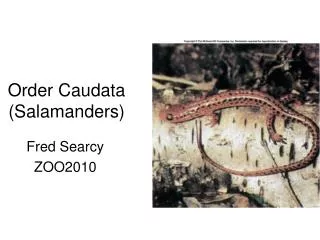
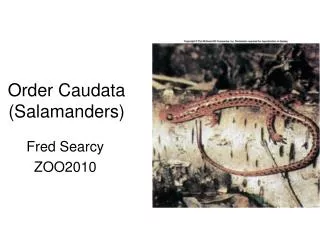
Order Caudata(Salamanders) Fred Searcy ZOO2010
Order Caudata(L caudatus = tail) • Salamanders & Newts • 360 species worldwide • Temperate, tropical, subtropical • Endangered
Structure • Usually < 15cm • Japanese giant salamander 1.5 m • Burrowing and aquatic forms may have rudimentary limbs or they may be missing • Terrestrial forms have limbs at right angles to the body
Nutrition • Carnivorous as larvae and adults • Protein rich • Fat & glycogen stored in small amounts • Most are opportunistic feeders but some actively search for prey • Teeth on upper and lower palate of mouth • Slow metabolism – less frequent eating required
Digestion • Large stomach proportional to body • Cardiac and pyloric sphincter • Pancreas • Liver • Gall bladder
Cardiovascular • Blood contains • Erythrocytes • Leucocytes • Thrombocytes • Circulatory System • Vessels • 3-chambered heart • Lymph • Lymph vessels
Respiration • Varied methods • Integument • External gills • Lungs • Both gills and lungs • Neither gills nor lungs (pull air across buccal vascular membranes of mouth) • Most have gills in larval stage • Some aquatic forms have no gills and must surface for air.
Urogenital System • Paired kidneys on either side of dorsal aorta • Bowman’s capsules present • Urinary bladder • Ammonia converted to urea • Some species convert urea to uric acid
Auditory & Vocal Functions • No ear drums, no middle ear cavity • Inner ear modified for sound perception • Lateral lines in larval and aquatic species (water current and pressure changes)
Skin, Pigmentation, Glands • Serous glands – may be toxic or noxious – some lethal • Concentrated behind head or in parotid gland (“warts”) on skin • Mucous glands • Keep skin moist • Prevent infections • Lubricate path through water • Chromatophores • Melanocytes • Cryptic coloration • Aposematic coloration (warning) • Iridophores • Xanthophores • Erythrophores
Thermoregulation and Metabolism • Poikilothermic (ectothermic) • Behavioral regulation
Aquatic species secrete pheromone Some terrestrial species rub chins Internal fertilization with spermatophore typical but some external fertilziation Eggs layed in strings with gelatinous layer Larva with gills & tails Oviparous, viviparous, ovoviviparous Breeding Behavior & Reproduction
Metamophrosis & Paedomorphosis • Some are aquatic throughout life and don’t undergo metamorphosis – they retain their gills as adults • Paedomorphism – adult retains some larval traits, e.g. gills • Necturus sexually mature in larval stage
Metamophrosis & Paedomorphosis • Ambystoma • Only change to adult under specific environmental conditions • E.g. pond dries up, change to adult • Larval form called axolotl • Can force metamorphosis by treating axolotl with thyroxine from thyroid gland





![[PDF] Free Download Codex supplement: Salamanders Enhanced Edition By Games Workshop](https://cdn4.slideserve.com/9009224/slide1-dt.jpg)