Understanding the Periodic Table: History, Structure, and Chemical Properties
270 likes | 386 Views
The periodic table is a systematic arrangement of chemical elements based on increasing atomic number. It is a powerful tool that helps predict the behavior and properties of elements. The history of the periodic table traces its evolution from the late 1700s, highlighting key figures like John Newlands, who proposed the Law of Octaves, and Dmitri Mendeleev, who created the first accepted version in 1869. The table organizes elements into groups and periods, revealing patterns in valence electrons and chemical behavior essential for students and chemists alike.


Understanding the Periodic Table: History, Structure, and Chemical Properties
E N D
Presentation Transcript
TOIPC: Periodic Table Organization Do Now: From your activity yesterday, and p.5 answer page 6 in your packet
Periodic Law • There is a periodic repetition of chemical and physical properties of elements when arranged by increasing atomic number
What is the periodic table? • compact way of organizing elements • contains a lot of information • allows us to make predictions about behaviour and properties of elements • Elements
History of the Periodic Table • End of the 1700’s – less than 30 elements known • Many elements discovered during 1800’s • Many experiments done to determine atomic masses
John Newlands • 1864: if elements arranged by atomic mass - properties repeat every 8th element • Law of Octaves • did not work for all known elements • Key idea was correct: Properties of elements do repeat in periodic way
Mendeleev & Meyer Mendeleev produced 1st accepted PT: 1869 • Elements ordered by ↑ atomic mass into columns with similar properties • Predicted existence & properties of undiscovered elements • Not totally correct • more accurate atomic mass calculations showed some elements weren’t in right place
Remember 1860’s: • No subatomic particles yet discovered • Dalton’s billiard ball model of the atom
1913 – Henry Moseley • by 1913, protons & electrons discovered • Neutrons were predicted • Moseley determined atoms of each element contain unique # protons (= atomic number) • rearranged Mendeleev’s PT by atomic number instead of mass • problems with elements in wrong place disappeared
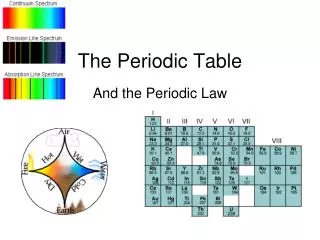
Periodic Table is arranged according atomic number and organized into groups and periods
COLUMNS Groups/Family numbering (1 18) left to right TELL US NUMBER OF VALENCE ELECTRONS (KIND OF)
Valence Electrons – electrons in the outer shell • Chemical behaviour determined by # valence electrons • Elements with same # valence electrons will have similar chemical properties • Elements in same column have similar chemical properties
Period Element Configuration 1 H 1 2 Li 2-1 3 Na 2-8-1 4 K 2-8-8-1 5 Rb 2-8-18-8-1 6 Cs 2-8-18-18-8-1 7 Fr 2-8-18-32-18-8-1 Going Down Column 1:
Group Number of Valence Electrons 1 or IA 1 2 or IIA 2 13 or IIIA 3 14 or IVA 4 Valence Electrons
COLUMNS CO L U MN • Aka groupsor families • #1 thru 18, Arabic numerals • (old way, Roman Numerals and letters) • - tell us number of valance electrons • (KIND OF) = works for 1,2, 13,14,15,16,17,18 Turn to packet page one, lets label the columns and valence electrons
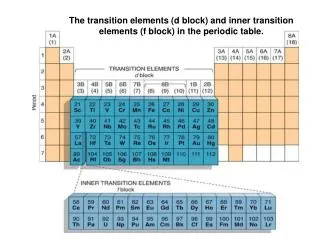
Names of Families(AKA group A elements) • Group 1 = Alkali Metals • Group 2 = Alkaline Earth Metals • Groups 3-12: Transition metals • Group 17 = Halogens • Group 18 = Noble Gases
Transition Metals (in yellow) • Groups 3 through 12
Glenn Seaborg: 1950’sf-Block Metals • Lanthanide (rare Earth metals) – can be found naturally on Earth, only 1 is radioactive • Actinide– all are radioactive, some are made in the lab. INCLUDES Uranium Turn to packet page one, lets label the the f-block metals
ROWS Period numbering (1 7) top to bottom TELL US NUMBER OF SHELLS (energy levels)
Energy Levels = Row Number • Elements in same row have same # of principal energy levels
ROWS • Rows are called series or periods • #1 thru 7 - TELL US HOW MANY ENERGY LEVELS ROW Turn to packet page one, lets label the periods