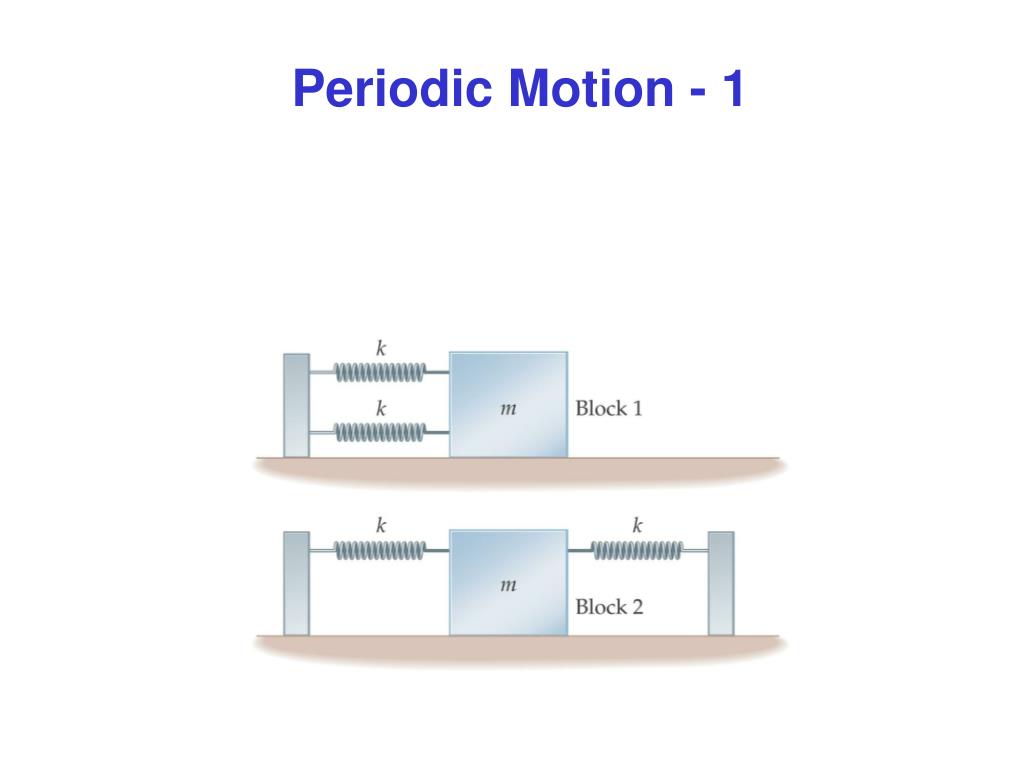
Periodic Motion - 1. Oscillatory/Periodic Motion Repetitive Motion Simple Harmonic Motion SHM special case of oscillatory. Mass on spring Pendulum with low amplitude. Vocabulary. Period T : time required for one cycle of periodic motion (sec).
An Image/Link below is provided (as is) to download presentation
Download Policy: Content on the Website is provided to you AS IS for your information and personal use and may not be sold / licensed / shared on other websites without getting consent from its author.Content is provided to you AS IS for your information and personal use only.Download presentation by click this link.While downloading, if for some reason you are not able to download a presentation, the publisher may have deleted the file from their server.During download, if you can't get a presentation, the file might be deleted by the publisher.
Vocabulary • Period T: time required for one cycle of periodic motion (sec). • Frequency: number of oscillations per unit time. unit is Hertz:
Equilibrium (0): the spot the mass would come to rest when not disturbed – Fnet = 0. • Displacement: (x) distance from equilibrium. • Amplitude (xo) – max displacement from eq. • Angular frequency w, multiply f by 2p. Reported as cy/sec or rad/sec. 2p = 1 full cycle.
Simple Harmonic Motion A spring exerts a restoring force proportional to the displacement fr. eq: Remember Hooke’s Law Negative sign – x opposite Fnet.
Simple Harmonic Motion On a bobbing mass: • No friction • Weight stays constant. • Tension increases with stretch. • Fnet / accl toward equilibrium position. • Fnet increases with is proportional to displacement.
Equations of Graphs • x = xocoswt x = xo sin wt • v = -vo sin wt v = vocoswt • a = -aocoswt -aosin wt • Released from Released equilibrium. top.
Ex 2. A mass on a spring is oscillating with f = 0.2 Hz and xo = 3 cm. What is the displacement of the mass 10.66 s after its release from the top? • x = xo cos wt xo = 3 cm • w = 2pf. = 0.4 p Hz =1.26 rad/s. • t = 10.66 s • x = 0.03 cos (1.26 x 10.66) = 0.019 m • You must use radians on calculator.
Mechanical Oscillations • A mechanical oscillation is a periodic conversion of E from P.E. to K.E to P.E. etc. • If a body oscillates it must be acted on by a force directed toward the equilibrium position. This force is called the restoring force. • Hooke’s law expresses the relationship btw F & x. • SHM is the simplest type of oscillatory motion.
If an object moving with constant speed in a circular path is observed from a distant point (in the plane of the motion), it will appear to be oscillating with SHM. The shadow of a pendulum bob moves with s.h.m. when the pendulum itself is either oscillating (through a small angle) or moving in a circle with constant speed, as shown in the diagram.
For any s.h.m. we can find a corresponding circular motion. When a circular motion "corresponds to" a given s.h.m., i) the radius of the circle is equal to the amplitude of the s.h.m. ii) the time period of the circular motion is equal to the time period of the s.h.m.
Derive Relationship between accl & w for SHM. From circular motion ac = v2/r Oscillating systems have acceleration too. • But w = 2p/T • vc = 2pr/T • vc = wr • But ac = v2/r • So ac = (wr)2/r
a = -w²x The negative sign shows Fnet & accl direction opposite displacement. Know the Derivation of accl in Hamper pg 76. Or use 2nd derivative of displacement.
Ex: A mass is bobbing on a spring with a period of 0.20 seconds. What is its angular acceleration at a point where its displacement is 1.5 cm? • w = 2p/T • .w = 31 rad/s • a = -w²x • a = (31rad/s)(1.5 cm) = 1480 cm/s2. • 15 m/s2.
Units of Chapter 4 • The Pendulum • Damped Oscillations • Driven Oscillations and Resonance
The Period of a Mass on a Spring Since the force on a mass on a spring is proportional to the displacement, and also to the acceleration, we find that . Make substitutions to find the relationship between T and k.
The Pendulum A simple pendulum consists of a mass m (of negligible size) suspended by a string or rod of length L (and negligible mass). The angle it makes with the vertical varies with time as a sine or cosine.
The Pendulum The restoring force is actually proportional to sinθ,whereas the restoring force for a spring is proportional to the displacement x.