Download
1 / 31
310 likes | 415 Views
Explore Chapter 11's insights on the Reconstruction era and the expansion into the American West. This period saw significant social and economic shifts, including the impact of sharecropping on freed slaves, the Radical Republicans' reforms, and the conflicts faced by Native Americans. Learn about key figures like Abraham Lincoln, Andrew Johnson, and the pioneers shaping industries from steel to oil. Understand the evolution of labor rights, the role of immigrants in the railroad industry, and the construction of the Transcontinental Railroad that unified the nation.

E N D
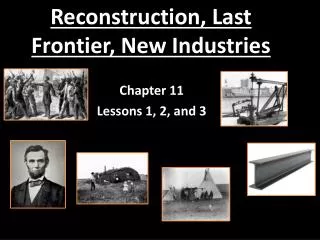
Reconstruction, Last Frontier, New Industries Chapter 11 Lessons 1, 2, and 3
16th President; freed slaves. • Abraham Lincoln
Private vote. • secret ballot
Southern states were placed under this rule by the Reconstruction plan put forward by the Radical Republicans in Congress. • U.S. military
These are the workers who farmed land owned by other people. • sharecroppers
Impeached in 1867. • Andrew Johnson
Laws that discriminate. • black codes
Period when South was rebuilt. • Reconstruction
Ex slaves rent farmland. • sharecropping
This is who got land from the Homestead Act. • Settlers who lived on the land for five years
This is why the United States wanted Native Americans to live on reservations. • So settlers could use the land
When pioneers settle land in the west. • homesteading
Lost Battle of Little Big Horn. • Custer
Economic downturn. • bust
Where Indians were forced to live. • reservation
Sioux chief at Little Big Horn. • Sitting Bull
These are the people the cattlemen had conflicts with during the Range Wars. • farmers
African American cowboy. • Nat Love
Person in search of gold. • prospector
Right of workers to negotiate work. • collective bargaining
Pioneer in steel industry. • Andrew Carnegie
Two immigrant groups from which thousands of railroad workers came. • Chinese and Irish
This is how many hours a day people in mills and factories worked in the late 1800’s. • 10 to 12
Organization of workers. • labor union
Another name for oil. • petroleum
Connected East and West Coast. • Transcontinental Railroad
This is where the Transcontinental Railroad was completed. • Promontory, Utah
Tall buildings. • skyscrapers
This person founded the first oil company. • John D. Rockefeller
GOOD LUCK!!! STUDY! STUDY! STUDY!