Download
1 / 6
60 likes | 174 Views
This study investigates the angular resolution critical for analyzing the source morphology of TeV emissions from Chandra SN 1006 using ASCA and Chandra data. It discusses the photon statistics and resolution requirements needed for precise photon parameter measurements, considering factors like background rejection and the efficiency of PMTs. Simulations demonstrate the effects of background noise and shower fluctuations on data accuracy. Understanding these parameters is essential for enhancing the observation capabilities of ground-based telescopes like H.E.S.S.

E N D
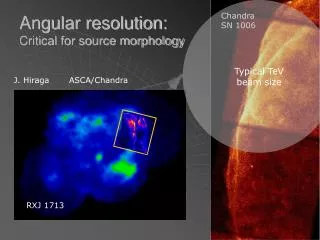
Typical TeV beam size Chandra SN 1006 J. Hiraga ASCA/Chandra RXJ 1713 Angular resolution:Critical for source morphology
Angular resolution limit perp. to B E-1/2
Angular resolutionhow many photons are needed? limited by photon stat. 100 GeV limited by shower fluct. 1 TeV Relative to PMT efficiency
Resolution required for photon parameters adding NSB: modest effect Photon direction Photon position 1 TeV 1 TeV 10 m dish 20 m dish H.E.S.S.
sy [m] sy [m] 2 TeV p 200 GeV p 1 TeV g 100 GeV g sy [m] sx [m] sx [m] Rejection: ~ 10-2 Background rejection: ProtonsScatter of (true) emission points Rejection: few 10-4 similar rejection obtained from fit (but low statistics)
preliminary g e ~ 30% e Electron background Try to track primary electron: count all photons approaching reconstructed shower axis within 10 m above h=17 km Simulations: 1 TeV ephoton = 1% with NSB