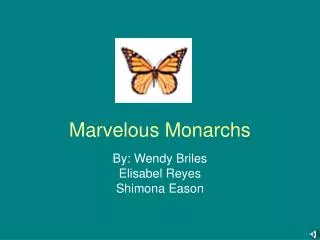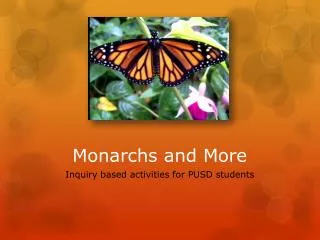
Monarchs and More: Engaging Inquiry-Based Activities for PUSD Students
440 likes | 562 Views
Dive into the world of monarch butterflies with our inquiry-based curriculum designed for PUSD students. This program harnesses citizen science to explore local ecosystems, basic ecological principles, and the significance of conservation. Students will engage in hands-on activities, including monitoring monarch larvae, data collection, and understanding environmental impacts on populations. The initiative fosters scientific literacy and community outreach through exhibits, newsletters, and educational support, promoting a cooperative effort in ecological knowledge generation.


Monarchs and More: Engaging Inquiry-Based Activities for PUSD Students
E N D
Presentation Transcript
Monarchs and More Inquiry based activities for PUSD students
“A Cooperative Effort to Generate and Share Ecological Knowledge” Citizen Science: • involves the public in organized scientific research • is often used in conservation, applied ecology and natural resource management • is an important tool in basic ecological research
Outreach/Dissemination Goal #1 • Understand local ecosystems and basic ecological principles • Understand the scientific process • Understand policy and conservation applications of ecological data Increased scientific literacy
Outreach/Dissemination Goal #2 • Exhibit for participating nature centers • Website • Annual newsletter conveying project findings, background information, links to other projects, etc. Dissemination to participants and community
Outreach/Dissemination Goal #3 • MLMP and extended research • Education for non-volunteer audience: data utilization, project findings Research/science education program for nature centers
Outreach/Dissemination Goal #4 K-12 Involvement • Participation in MLMP via school/teacher • Via ISE (visits to nature centers, summer involvement) • Data/curriculum utilization Link formal education community, ISE and scientists
University of Minnesota • Training, Resources, Protocol • Provide training materials • Provide hands-on practice with monitoring and larva ID • Directions for training and recruiting • Develop protocol • Project communication and support • Newsletter, website, networking (naturalists and volunteers) • Nature center and site displays • Online support and field questions • Data analysis and dissemination • Evaluation
Project Activities Goal #1 Provide baseline data on monarch population biology for educators, scientists, policy makers, and the public • Basic distribution and abundance data • Temporal and spatial comparisons • Importance of various monarch habitats • Effects of environmental perturbations • Population dynamics (e.g. predation, timing of mortality)
Project Activities Goal #2 Provide trainer and volunteer support • Encourage and facilitate communication • Retain volunteers • Disseminate findings • Make data collection and entry easy and meaningful • On-line tutorial • Data sheets and directions • Assuring quality data
Monarchs and MoreInquiry & Arthopod based curriculumSchoolyard Ecology ExplorationsInquiry based curriculum • Interdisciplinary, inquiry based supplement to classroom instruction. • Life science, math, reading, writing, art, and social studies • Teaches scientific method related to life cycle and ecology of monarch butterflies and other insects. • Utilizes schoolyard exploration /butterfly friendly garden.
Female Male
Monarch Ecology • Host plants • Other insects that eat host plants • Predators • Nectar plants • Abiotic conditions (temperature, precipitation, etc.)