Educational Objectives
Educational Objectives. Quantifying Learning. Educational Objectives. Motivation Components Authorities Taxonomies in detail How to Examples. Why Write Educational Objectives for Your Course?. To tell students what they will be expected to learn

Educational Objectives
E N D
Presentation Transcript
Educational Objectives Quantifying Learning Gateway Engineering Education Coalition
Educational Objectives • Motivation • Components • Authorities • Taxonomies in detail • How to • Examples Gateway Engineering Education Coalition
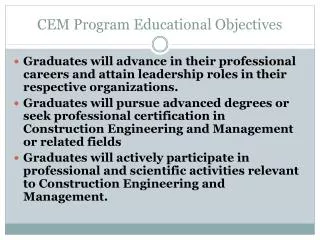
Why Write Educational Objectives for Your Course? • To tell students what they will be expected to learn • To ensure that students learn on a number of cognitive levels • To quantify assessment by creating measurable objectives Gateway Engineering Education Coalition
Components of an Educational Objective* • The task that the student is to do (i.e., the behavior) • The conditions under which the behavior is to be displayed • The level of achievement expected *Teaching Engineering, Wankat and Oreovicz Gateway Engineering Education Coalition
Who has published information about writing objectives? • Bloom • Cognitive Domain – 6 levels • Krathwohl • Affective Domain – 4 levels • Kibler • Psychomotor Domain – 4 levels • Plants, Sears and Dean • Problem Solving Taxonomy – 5 levels Gateway Engineering Education Coalition
Bloom’s Taxonomy:Cognitive Domain • Knowledge • Comprehension • Application • Analysis • Synthesis • Evaluation Gateway Engineering Education Coalition
Bloom’s Taxonomy: Cognitive Domain • Knowledge – Repeating from memory • Comprehension – Demonstrating understanding of terms and concepts • Applications – Applying learned information to solve a problem Gateway Engineering Education Coalition
Bloom’s Taxonomy:Cognitive Domain • Analysis – Breaking things down into their elements, formulating theoretical explanations or mathematical or logical models for observed phenomena • Synthesis – Creating something, combining elements in novel ways • Evaluation – Choosing from alternatives and justifying the choice using specified criteria Gateway Engineering Education Coalition
Bloom’s Taxonomy:Cognitive Domain • Descriptive Verbs: • Knowledge – list, identify, summarize • Comprehension – explain, describe, interpret • Application – apply, calculate, solve • Analysis – derive, explain, classify • Synthesis – formulate, design, create • Evaluation – determine, optimize, select Gateway Engineering Education Coalition
Krathwohl’s Taxonomy:Affective Domain • Receiving and attending – willing to receive or reject new information • Responding – willing to respond to information • Valuing – decides that information has inherent worth • Organization – organizes values into a system • Characterization by a value – acts in a way that allows others to see his or her underlying values Gateway Engineering Education Coalition
Kibler’s Taxonomy: Psychomotor Domain • Gross Body Movements • Finely Coordinated Body Movements • Non-verbal Communication Behaviors • Speech Behaviors Gateway Engineering Education Coalition
Plants, Sears, & Dean:Problem Solving Taxonomy • Routines – no decisions required • Diagnosis – selection of correct routine • Strategy – choice of routine and order to apply • Interpretation – solve real world problem requiring assumptions and interpretations • Generation – development of routines that are new to the user Gateway Engineering Education Coalition
Educational Objectives • Overall objectives • Outside review of objectives • Detailed objectives for individual sections • Weekly objectives • Daily objectives Gateway Engineering Education Coalition
Which Taxonomies Could You Use? • Depends on your course • Bloom’s taxonomy is better known with more examples • Bloom’s taxonomy may not allow definition of physical characteristics or behaviors • Educational objectives for an engineering course may be a combination of cognitive and psychomotor Gateway Engineering Education Coalition
Examples – Bloom’s Taxonomy • Knowledge – The student can identify the six orthographic views and oblique and isometric pictorial views • Comprehension - Explain in your own words the concept of vapor pressure • Application – Given two orthographic views of a 3D object, the student can determine the third through sixth orthographic views and draw the pictorial view Gateway Engineering Education Coalition
Examples – Bloom’s Taxonomy • Analysis – The student can dimension the orthographic views of an object so that a machinist could produce the object. • Synthesis – Formulate a model-based alternative to the PID controller design • Evaluation – Determine which of the given heat exchanger configurations is better and explain your reasoning Gateway Engineering Education Coalition
Examples – Kibler’s Taxonomy • Given a multifaceted block, the student can sketch to scale three orthographic views and a pictorial view of the block • Having completed a team design-build project the student can prepare and deliver a clear, oral project presentation Gateway Engineering Education Coalition
References • Wankat, P. C. and F. S. Oreovicz, Teaching Engineering, New York, McGraw-Hill, 1993. • Felder, R. M. and R. Brent, “Objectively Speaking”, Chemical Engineering Education, 31(3), 178-179 (1997). • Bloom, B. S., Taxonomy of educational objectives. 1. Cognitive domain. New York, Longman, 1984. Gateway Engineering Education Coalition