Understanding the Urinary System: Nephron Anatomy and Filtration Mechanisms
530 likes | 653 Views
Explore the essential components of the urinary system, focusing on the nephron's anatomy and the renal tubules responsible for urine filtration. This educational content covers various aspects, including the path of urine from the kidneys through the ureters to the bladder, the structure of the renal corpuscle, and the mechanisms governing glomerular filtration rates. Test your knowledge through engaging questions that challenge your understanding of renal anatomy and function.


Understanding the Urinary System: Nephron Anatomy and Filtration Mechanisms
E N D
Presentation Transcript
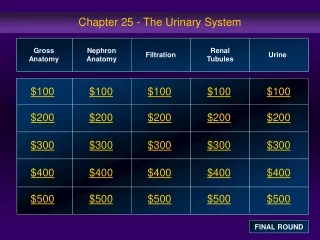
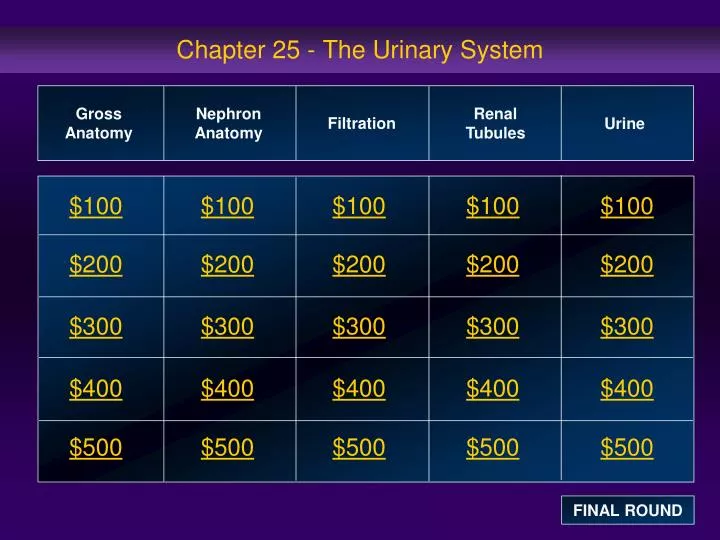
Chapter 25 - The Urinary System Gross Anatomy Nephron Anatomy Renal Tubules Filtration Urine $100 $100 $100 $100 $100 $200 $200 $200 $200 $200 $300 $300 $300 $300 $300 $400 $400 $400 $400 $400 $500 $500 $500 $500 $500 FINAL ROUND
Gross Anatomy:$100 Question • The tube that carries urine from the kidney to the urinary bladder is the: • a. urethra • b. ureter • c. collecting duct • d. renal vein ANSWER BACK TO GAME
Gross Anatomy:$100 Answer • The tube that carries urine from the kidney to the urinary bladder is the: • a. urethra • b. ureter • c. collecting duct • d. renal vein BACK TO GAME
Gross Anatomy:$200 Question • The renal medulla is also called the: • a. renal papilla • b. renal columns • c. renal pyramids • d. renal capsule ANSWER BACK TO GAME
Gross Anatomy:$200 Answer • The renal medulla is also called the: • a. renal papilla • b. renal columns • c. renal pyramids • d. renal capsule BACK TO GAME
Gross Anatomy:$300 Question • The space inside the kidney is the: • a. renal hilum • b. retroperitoneal space • c. renal pelvis • d. renal sinus ANSWER BACK TO GAME
Gross Anatomy:$300 Answer • The space inside the kidney is the: • a. renal hilum • b. retroperitoneal space • c. renal pelvis • d. renal sinus BACK TO GAME
Gross Anatomy:$400 Question • Which of the following empties urine directly into the renal pelvis? • a. ureter • b. renal papilla • c. major calyx • d. minor calyx ANSWER BACK TO GAME
Gross Anatomy:$400 Answer • Which of the following empties urine directly into the renal pelvis? • a. ureter • b. renal papilla • c. major calyx • d. minor calyx BACK TO GAME
Gross Anatomy:$500 Question • Which of the following vessels would be found in the renal columns? • a. segmental artery • b. cortical radiate artery • c. interlobar artery • d. arcuate artery ANSWER BACK TO GAME
Gross Anatomy:$500 Answer • Which of the following vessels would be found in the renal columns? • a. segmental artery • b. cortical radiate artery • c. interlobar artery • d. arcuate artery BACK TO GAME
Nephron Anatomy:$100 Question • Nephrons are found mostly in the: • a. renal medulla • b. renal cortex • c. renal capsule • d. renal sinus ANSWER BACK TO GAME
Nephron Anatomy:$100 Answer • Nephrons are found mostly in the: • a. renal medulla • b. renal cortex • c. renal capsule • d. renal sinus BACK TO GAME
Nephron Anatomy:$200 Question • The renal corpuscle consists of: • a. renal tubules • b. glomerulus • c. glomerular capsule • d. both b. and c. are correct ANSWER BACK TO GAME
Nephron Anatomy:$200 Answer • The renal corpuscle consists of: • a. renal tubules • b. glomerulus • c. glomerular capsule • d. both b. and c. are correct BACK TO GAME
Nephron Anatomy:$300 Question • Which of the following structures is not part of the nephron? • a. distal convoluted tubule • b. glomerulus • c. loop of Henle • d. collecting duct ANSWER BACK TO GAME
Nephron Anatomy:$300 Answer • Which of the following structures is not part of the nephron? • a. distal convoluted tubule • b. glomerulus • c. loop of Henle • d. collecting duct BACK TO GAME
Nephron Anatomy:$400 Question • Podocytes are part of the: • a. filtration slits • b. glomerular fenestrated epithelium • c. glomerular capsule • d. proximal convoluted tubule ANSWER BACK TO GAME
Nephron Anatomy:$400 Answer • Podocytes are part of the: • a. filtration slits • b. glomerular fenestrated epithelium • c. glomerular capsule • d. proximal convoluted tubule BACK TO GAME
Nephron Anatomy:$500 Question • The visceral layer of the glomerular capsule is part of the: • a. juxtaglomerular apparatus • b. loop of Henle • c. filtration membrane • d. renal tubules ANSWER BACK TO GAME
Nephron Anatomy:$500 Answer • The visceral layer of the glomerular capsule is part of the: • a. juxtaglomerular apparatus • b. loop of Henle • c. filtration membrane • d. renal tubules BACK TO GAME
Filtration:$100 Question • Which of the following conditions would increase the glomerular filtration rate? • a. an increase in colloid osmotic pressure • b. an increase in glomerular hydrostatic pressure • c. an increase in capsular hydrostatic pressure • d. all of the above would increase GFR ANSWER BACK TO GAME
Filtration:$100 Answer • Which of the following conditions would increase the glomerular filtration rate? • a. an increase in colloid osmotic pressure • b. an increase in glomerular hydrostatic pressure • c. an increase in capsular hydrostatic pressure • d. all of the above would increase GFR BACK TO GAME
Filtration:$200 Question • Which of the following substances would not be found in normal filtrate? • a. albumin • b. glucose • c. potassium • d. urea ANSWER BACK TO GAME
Filtration:$200 Answer • Which of the following substances would not be found in normal filtrate? • a. albumin • b. glucose • c. potassium • d. urea BACK TO GAME
Filtration:$300 Question • Which of the following would be a result of an increase in systemic blood pressure? • a. afferent arterioles constrict • b. efferent arterioles constrict • c. afferent arterioles dilate • d. GFR increases dramatically ANSWER BACK TO GAME
Filtration:$300 Answer • Which of the following would be a result of an increase in systemic blood pressure? • a. afferent arterioles constrict • b. efferent arterioles constrict • c. afferent arterioles dilate • d. GFR increases dramatically BACK TO GAME
Filtration:$400 Question • What is the NFP if GHP is 60mmHg, COP is 35mmHg and CHP is 25mmHg? • a. 120mmHg • b. 70mmHg • c. 40mmHg • d. 0mmHg ANSWER BACK TO GAME
Filtration:$400 Answer • What is the NFP if GHP is 60mmHg, COP is 35mmHg and CHP is 25mmHg? • a. 120mmHg • b. 70mmHg • c. 40mmHg • d. 0mmHg BACK TO GAME
Filtration:$500 Question • Which of the following will reduce the glomerular filtration pressure? • a. angiotensin II • b. increased GHP • c. ADH • d. aldosterone ANSWER BACK TO GAME
Filtration:$500 Answer • Which of the following will reduce the glomerular filtration pressure? • a. angiotensin II • b. increased GHP • c. ADH • d. aldosterone BACK TO GAME
Renal Tubules:$100 Question • Most of the nutrients in the filtrate are reabsorbed from the: • a. proximal convoluted tubule • b. distal convoluted tubule • c. loop of Henle • d. glomerular capsule ANSWER BACK TO GAME
Renal Tubules:$100 Answer • Most of the nutrients in the filtrate are reabsorbed from the: • a. proximal convoluted tubule • b. distal convoluted tubule • c. loop of Henle • d. glomerular capsule BACK TO GAME
Renal Tubules:$200 Question • At the distal tubule a _____ is secreted for every sodium ion that is reabsorbed. • a. chloride ion • b. bicarbonate ion • c. potassium ion • d. calcium ion ANSWER BACK TO GAME
Renal Tubules:$200 Answer • At the distal tubule a _____ is secreted for every sodium ion that is reabsorbed. • a. chloride ion • b. bicarbonate ion • c. potassium ion • d. calcium ion BACK TO GAME
Renal Tubules:$300 Question • When glucose spills over into the urine it has: • a. been secreted • b. been filtered and secreted • c. exceeded its transport maximum • d. been completely cleared from the blood ANSWER BACK TO GAME
Renal Tubules:$300 Answer • When glucose spills over into the urine it has: • a. been secreted • b. been filtered and secreted • c. exceeded its transport maximum • d. been completely cleared from the blood BACK TO GAME
Renal Tubules:$400 Question • If your urine contains less potassium ions that your filtrate then the potassium has been: • a. filtered and secreted • b. filtered and reabsorbed • c. filtered only • d. secreted only ANSWER BACK TO GAME
Renal Tubules:$400 Answer • If your urine contains less potassium ions that your filtrate then the potassium has been: • a. filtered and secreted • b. filtered and reabsorbed • c. filtered only • d. secreted only BACK TO GAME
Renal Tubules:$500 Question • Which of the following is actively transported out of the renal tubules? • a. chloride ion • b. potassium ion • c. sodium ion • d. urea ANSWER BACK TO GAME
Renal Tubules:$500 Answer • Which of the following is actively transported out of the renal tubules? • a. chloride ion • b. potassium ion • c. sodium ion • d. urea BACK TO GAME
Urine:$100 Question • Which of the following would be an abnormal constituent of urine? • a. sodium • b. potassium • c. albumin • d. urea ANSWER BACK TO GAME
Urine:$100 Answer • Which of the following would be an abnormal constituent of urine? • a. sodium • b. potassium • c. albumin • d. urea BACK TO GAME
Urine:$200 Question • The collecting ducts are _____ to water when the hormone _____ is present. • a. permeable, ADH • b. permeable, aldosterone • c. impermeable, ADH • d. impermeable, aldosterone ANSWER BACK TO GAME
Urine:$200 Answer • The collecting ducts are _____ to water when the hormone _____ is present. • a. permeable, ADH • b. permeable, aldosterone • c. impermeable, ADH • d. impermeable, aldosterone BACK TO GAME
Urine:$300 Question • Which of the following would be an abnormal pH for urine? • a. 5.0 • b. 6.0 • c. 8.0 • d. 11.0 ANSWER BACK TO GAME
Urine:$300 Answer • Which of the following would be an abnormal pH for urine? • a. 5.0 • b. 6.0 • c. 8.0 • d. 11.0 BACK TO GAME
Urine:$400 Question • The portion of the nephron that maintains the hypertonicity of the renal medulla is the: • a. proximal convoluted tubule • b. glomerulus • c. loop of Henle • d. distal convoluted tubule ANSWER BACK TO GAME
Urine:$400 Answer • The portion of the nephron that maintains the hypertonicity of the renal medulla is the: • a. proximal convoluted tubule • b. glomerulus • c. loop of Henle • d. distal convoluted tubule BACK TO GAME
Urine:$500 Question • When urine enters the collecting duct it is ______ to the blood. • a. hypotonic • b. hypertonic • c. isotonic • d. isoosmotic ANSWER BACK TO GAME