Download
1 / 5
50 likes | 185 Views
This article explores the concept of saturation in inverting operational amplifiers (op-amps). While the gain of an op-amp is theoretically defined as the ratio of feedback resistor Rf to input resistor R1, this relationship holds true only until the output voltage approaches the limits of the power supply. As input voltage increases, the op-amp's output can saturate, typically capping at about 85% of the supplied voltage (e.g., ±15V). Understanding saturation is crucial for effective op-amp circuit design and operation.

E N D
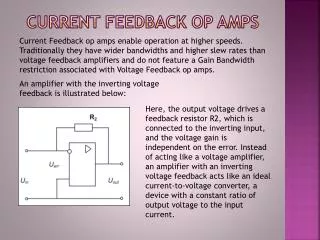
The Inverting Mode Op-Amp Rf R1 +Vs - + -Vs V1 Vo 0 V In theory, the gain of the op-amp is given by Rf÷ R1. This equation works well until the output voltage increases too much. We must remember that the op-amp has a power supply.
By increasing the input voltage, we find that the output voltage is limited. The op-amp cannot give out any more than about 85% of the voltage it is being supplied with (±15 V). We say that the op-amp saturates.
The gain equation works well on this part of the graph. Op-amp is saturated Op-amp is saturated
Saturation • The op-amp will saturate if the input voltage is increased too much or if the gain is increased too much.