Intermolecular Forces in Chemical Bonds
120 likes | 181 Views
Explore the different types of covalent compounds, intermolecular forces, and their strengths, affecting the state of matter. Learn about dipole-dipole, hydrogen bonding, and London dispersion forces that hold substances together and influence their properties. Discover the distinction between ionic and covalent bonds, including melting points, conductivity, and solubility in water.


Intermolecular Forces in Chemical Bonds
E N D
Presentation Transcript
What Holds A Liquid Or Solid Together? • In ionic compounds, all atoms are equally bonded together in the crystal • What about covalent?
Two Types of Covalent Compounds • Covalent Network Crystal - all atoms covalently bonded together equally - very strong and hard - ex: diamond, graphite
Covalent Molecular Substance - individual molecules attracted to one another through intramolecular forces - not anywhere near as strong as networks - ex: water
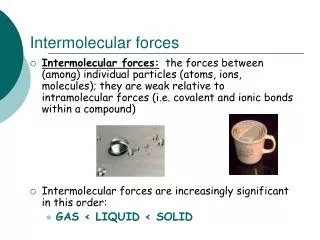
Intermolecular Forces • Force of attraction between molecules in a covalent molecular substance • Three types: Dipole – Dipole forces Hydrogen Bond London Dispersion forces
Dipole- Dipole • Between polar molecules • Positive pole of one ion attracted to the negative pole of another
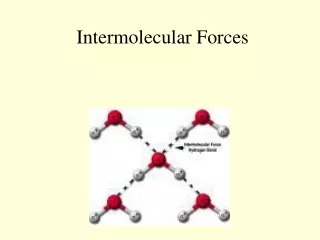
Hydrogen Bonding • Attraction between hydrogen atom in one molecule and an unshared pair of electrons on the atom of another molecule
London Dispersion or Van der Walls Force • Hold non-polar molecules together • Caused by motion of electrons
Strength of Interaction • Substances held together by ionic bonds or covalent network bonds are very rigidly connected: mostly solid at room temp and melt at very high temps • Those held by dipole-dipole or hydrogen bonds are fairly strongly connected: liquid at room temp or solids that melt at low temps • Those held by london dispersion forces are weakly connected: gases at room temp; need to be very cold to become liquid
Ionic Covalent Molecular Melting Point High Low Vaporize No Maybe Crystalline Yes, hard & brittle Maybe, soft Dissolve in Water Yes Mostly no Conduct electricity when liquid Yes No Conduct electricity when dissolve in water Yes No Ionic vs. Covalent
Example Substance A melts at 600oC, dissolves well in water, and does not conduct electricity when solid but does when dissolved in water. Is the substance held together by ionic or covalent bonds?