Intermolecular Forces
Explore the fascinating world of intermolecular forces and their impact on the physical and chemical properties of covalent molecules. Discover how electronegativity creates dipoles, leading to polar covalent bonds. Learn about various types of intermolecular forces, including hydrogen bonding, dipole-dipole interactions, and London dispersion forces. Understand why these forces, though weaker than intramolecular forces, are crucial in determining boiling and melting points. Delve into real-world examples and applications in chemistry.

Intermolecular Forces
E N D
Presentation Transcript
Intermolecular Forces Understanding the Reason behind the physical and Chemical Behavior of Covalent Molecules
F H F H d- d+ The electronegativity of an atom can create a dipole, or polar molecule. electron rich region electron poor region Polar covalent bond or polar bond : covalent bond with greater electron density around one of the two atoms
Generally, intermolecular forces are much weaker than intramolecular forces. Intermolecular forces: attractive forces betweenmolecules. Intramolecular forces: hold atoms together, attractive forces within a molecule.
Intermolecular vs Intramolecular • 41 kJ to vaporize 1 mole of water (inter) • 930 kJ to break all O-H bonds in 1 mole of water (intra) “Measure” of intermolecular force boiling point melting point
F F F F F H H H H H Dipole-Dipole Forces • Attractive forces between polar molecules • Partially + end of one dipole is attracted to the partially -- end of another dipole
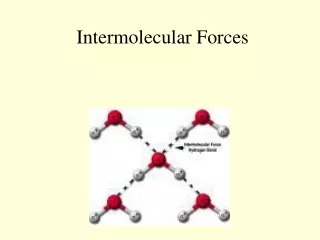
Hydrogen Bonding The hydrogen bond is a special dipole-dipole interaction between they hydrogen atom in a polar N-H, O-H, or F-H bond and an electronegative O, N, or F atom. http://www.ck12.org/user:krogers/section/Intermolecular-Forces-of-Attraction/
Decreasing molar mass Decreasing boiling point Why is the hydrogen bond considered a “special” dipole-dipole interaction?
Induced-Dipole Forces Attractive forces when a polar molecule causes a nonpolar molecule to temporarily have a dipole induced dipole interaction by polar molecule induced dipole interaction (by an ion)
London Dispersion Forces • Attractive forces between two nonpolar molecules • In polar or nonpolar atoms, electrons are in continuous motion. • At any instant the electron distribution may be uneven. A momentary uneven charge can create a positive pole at one end of an atom of molecule and a negative pole at the other.
O O S What type(s) of intermolecular forces exist between each of the following molecules? HBr HBr is a polar molecule: dipole-dipole forces. There are also dispersion forces between HBr molecules. CH4 CH4 is nonpolar: dispersion forces. SO2 SO2 is a polar molecule: dipole-dipole forces. There are also dispersion forces between SO2 molecules.