296-297
This overview explores diverse governmental responses to climate change challenges faced by regions like Bolivia, Norway, and Alberta. The Intergovernmental Panel on Climate Change exemplifies collaborative global governance. Bolivia's concern over glacier recession in Tuni Condoriri highlights urgent local water supply issues. Meanwhile, Norway’s collaboration in establishing the Svalbard Global Seed Vault aims to safeguard biodiversity against losses. Alberta, as Canada’s highest greenhouse gas emitter, solicits public input on climate goals, emphasizing the importance of local engagement in climate action.

296-297
E N D
Presentation Transcript
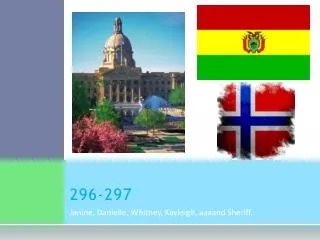
296-297 Janine, Danielle, Whitney, Kayleigh, aaaand Sheriff.
Changing government policies • The intergovernmental panel on climate change is an example of joint government to meet challenges of dealing with climate change.
bolivia • Their government is concerned with the rate at which the glaciers in the Tuni Condoriri are receding . From 1983 til 2006, glaciers shrank more than a third. our drinking water supplies are decreasing as well.
Norway • The Norwegian government and the Global Crop Diversity Trust foundations have co founded the Svalbard Global seed vault. The goal is to prevent the kind of loss that occurred in the united states, were 6800 of the 7100 varieties of apples no longer exist.
Alberta • The province of Alberta has the highest greenhouse gas emissions in Canada, despite their lower population. People in Alberta were asked the four questions • What goals do you want set? • What important steps need to be taken? • What actions should Albertans take? • What role can individuals play?
Video • http://video.google.com/videoplay?docid=5617318652349295608# 3:35-5:02