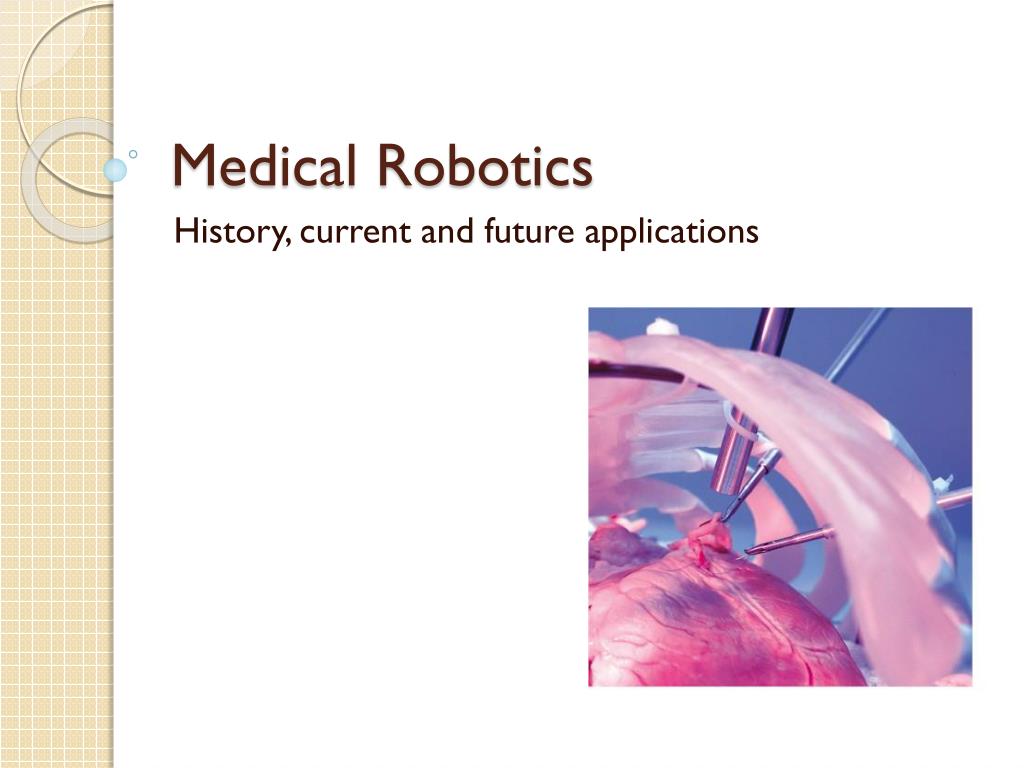
Medical Robotics History, current and future applications
Overview • Introduction • Classification • Application of Medical Robotics • Design of Robotic Telesurgery • Historic Companies and Systems • Existing surgical systems • Strengths and Limitations • Ethical and Safety Considerations • Challenges, Future and Conclusion
Introduction(1) • Definition: Robotic systems for surgery • There are computer-integrated surgery (CIS) systems first, and “medical robots” second. The robot itself is just one element of a larger system designed to assist a surgeon in carrying out a surgical procedure..” [Taylor, 2003]
Introduction(2) • CIS • Information flow in CIS
Introduction(3) • Motivation: • Started with the weaknesses and strengths of minimally invasive surgery (MIS) • Smaller incisions, shorter post-operative time, reduced infection, faster rehabilitation, lesser pain, better cosmetics, ... • Eye-hand coordination, difficulty in moving arms, degree of motion
Introduction(4) • MIS • Minimally invasive surgery uses techniques of surgical access and exposure that significantly reduce trauma to the body compared to traditional incisions.
Classification • Depending on the degree of surgeon interaction during the procedure: • Supervisory-controlled; • Telesurgical; • Shared-control;
Application of Medical Robotics(1) • Laboratory Robots • For pre-programmed tasks • High repetitions • Perform multiple-tests in parallel • Manufacturers include, Thermo Electron Corp, Hamilton Co, Central Research Laboratories (CRL), A Dover Diversified Co etc.
Application of Medical Robotics(2) • Telesurgery • Surgeon sits at a console • Has controls to move the robotic arms • Does not operate on the patient directly • Mainly used in minimally invasive surgeries
Application of Medical Robotics(3) • Surgical Training • Robots used as surgical training simulators • Used for medical resident students • Residents lack expertise and this helps in avoiding legal, social and economic problems • The Second Generation Robotic Telesurgical System for Laparoscopy during tests in the Experimental Surgery Lab at UC San Francisco
Application of Medical Robotics(4) • Telemedicine and Teleconsultation • Telecommunciation channels to communicate with other physicians/patients • Control an external camera which in turn controls an endoscopic camera – used to share images with a remote surgeon
Application of Medical Robotics(5) • Rehabilitation • Assistive robots • Wheelchair with intelligent navigational control system
Application of Medical Robotics(6) • Remote surgery • Surgeon can be anywhere in the world • Remotely controls the robotic surgical system • Very useful for treating wounded people in battlefields
Application of Medical Robotics(7) • Laparoscopic Surgery • Performed in the abdominal cavity using MIS • Abdomen cavity is expanded using CO2 • Uses Laparoscopic instrument • Fiber optic channels to illuminate the inside of abdominal cavity • Lens optics to transmit image • CCD camera at the outer end • Image displayed on high resolution TV
Application of Medical Robotics(8) • Laparoscopic Surgery • Traditional laparoscope instruments have limitations • Has 4 DOFs - Arbitrary orientation of instrument tip not possible • Reduction in dexterity • Reduction in motion reversal due to fulcrum at entry point • Friction at air tight trocar – reduction in force feedback • Lack of tactile sensing
Design of Robotic Telesurgery(1) • Minimally Invasive Surgery • Surgery performed by making small incisions < 10mm dia • Reduces post-operative pain and hospital stays • Form of telemanipulation • Instruments have a camera attached to transmit inside image to the surgeon
Design of Robotic Telesurgery(2) • The Concept • Telerobotics is a natural tool to extend capabilities in MIS • The goal is to restore the manipulation and sensation capabilities of the surgeon • Using a 6 DOF slave manipulator, controlled through a spatially consistent and intuitive master
Design of Robotic Telesurgery(3) • The Concept • Telesurgical system concept
Design of Robotic Telesurgery(4) • Considerations: • Compatibility • Backdrivabilit • Actuator’s impedance • Actuators receive tool-to-tissue force • Loss of power can lead to dropping of a heavy tool and undesirable high accelerations in the actuator
Design of Robotic Telesurgery(5) • Considerations: • Human-Machine Interface • Video system used to capture images inside the patient • Backlash-loss of motion between a set of movable parts • Choose the appropriate mechanism for the required transmission • Choose passive gravity balance over active gravity balance
Design of Robotic Telesurgery(6) • Haptic Feedback • Sensation of touch lost in robotic surgery • Receiving haptic information and using it to control the robotic manipulators • Needed to achieve high fidelity • Types • Force (kinesthetic) feedback • Tactile (cutaneous) feedback
Design of Robotic Telesurgery(7) • Haptic Feedback • Hand tie – tradition suturing mechanism • Instrument tie – estimate of performance (same type of feedback as resolved-force feedback) • Robotic tie – suturing task performed by da Vinci®
Design of Robotic Telesurgery(8) • Haptic Feedback • Experimental results • Accuracy cannot be improved to the level of hand ties by using force feedback • Hand tie had the lowest NSD. Repeatability can be improved by using force feedback in robotic surgical systems • Both instrument and robot reduces the performance margin between expert and novice users
Design of Robotic Telesurgery(9) • Haptic Feedback • Fidelity – ability to detect compliance variations in the environment • P (Position error) +FF (kinesthetic force feedback) control architecture – to determine if the use of force sensor on slave manipulator will provide fidelity
Historic Companies and Systems(1) • First Robotic assisted surgery 1988 • – PUMA 560 • – Light duty industrial robotic arm to guide laser/needle for sterostactic brain surgery
Historic Companies and Systems(2) • First Robotic urological surgery 1992 • – PROBOT-assisted TURP in Guy’s Hospital in London leaded by Wickham
Historic Companies and Systems(3) • First commercially available robotic system, 1992 • – ROBODOC for orthopaedic hip surgery
Historic Companies and Systems(4) • First RCT of transatlantic telerobotics surgery • – Between Guy’s and John Hopkins Hospitals • – PAKY-RCM percutaneous access robot (Kavoussi group developed in 1996)
Existing surgical systems(1) • AESOP (Computer Motion), 1994 • – Automated Endoscopic System for Optimal Positioning – a voice-activated robotic arm for camera holder • – First approved surgical robotic system by FDA
Existing surgical systems(2) • AESOP
Existing surgical systems(3) • ZEUS (Computer Motion) • – Marketed in 1998
Existing surgical systems(4) • Da Vinci (Intuitive Surgical) • – Initially developed by US Department of Defence in 1991 • – Intuitive Surgical acquired the prototype and commercialized the system • – Approved by FDA in July 2000
Existing surgical systems(5) • Da Vinci Surgical® system by Intuitive Surgical, Inc.
Existing surgical systems(6) • Da Vinci Surgical® system by Intuitive Surgical, Inc. • Surgical Console - 3D display and master control • Patient side cart - two or three instrument arms and one endoscope arm • EndoWrist Instrument - 7 DOFs, quick-release levers • InSite Vision System - high resolution 3D endoscope and image processing equipment
Existing surgical systems(7) • Da Vinci Surgical® system by Intuitive Surgical, Inc.
Existing surgical systems(8) • Da Vinci Surgical® system by Intuitive Surgical, Inc. • Video
Existing surgical systems(9) • Advantages of Da Vinci Surgical®: • Technically • – Patented Endowrist: 6 degrees of movement • – 3-D vision (Dual channel endoscopy) and magnified view (x12) • – Tremor suppression and scaling of movement Surgeon • – Ergonomic advantage • – Shorter learning curve • Patient • – Better outcome
Existing surgical systems(10) • Advantages:
Existing surgical systems(11) • 6 degree movements
Existing surgical systems(12) • Da Vinci surgical system in a general procedure setting
Existing surgical systems(13) • daVinci® Surgical System U.S. Installed Base 1999 – 2008
Strengths and Limitations(1) • Strengths: • Physical separation • Wrist action • Tremor elimination • Optional motion scaling • Three-dimensional stereoscopic image • Electronic information transfer (Telesurgery)
Strengths and Limitations(2) • Limitation • Reluctance to accept this technology (trust) • Additional training • Fail proof? • Most of the sensors use IR transmission • Highly efficient visual instruments are needed • Cannot be pre-programmed • Task-specific robots are required • Latency in transmission of mechanical movements by the surgeon • Longer operating time
Strengths and Limitations(3) • Limitation • Cost for the Da Vinci system: • The average base cost of a System is $1.5 million • Approximately $ 160,000 maintenance cost a year • Operating room cost, $150 per hour • Hospital stay cost, $600 per day • Time away from work, $120 per day
Ethical and Safety Considerations • When there is a marginal benefit from using robots, is it ethical to impose financial burden on patients or medical systems? • If a robot-assisted surgery fails because of technical problems, is it the surgeon who is responsible or others?
Challenges, Future and Conclusion • Haptic feedback • A safe, easy sterilizable, accurate, cheap and compact robot • Reliable telesurgical capabilities • Compatibility with available medical equipment and standardizing • Autonomous robot surgeons
Reference • Robotics in surgery: history, current and future applications. New York: Nova Science Pub-. lishers; 2007 • J.E. Speich, J. Rosen, 'Medical Robotics,' In Encyclopedia of Biomaterials and Biomedical Engineering, pp. 983-993, Marcel Dekker, New York, 2004. • http://robotics.eecs.berkeley.edu/medical/laparobot.html • http://biomed.brown.edu/Courses/BI108/BI108_2005_Groups/04/index.html • http://faculty.cs.tamu.edu/dzsong/teaching/fall2005/cpsc689/
Thanks!