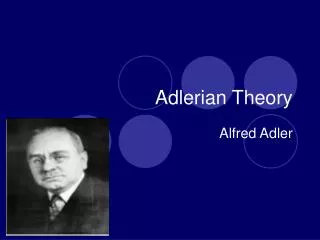
Adlerian Theory
350 likes | 2.42k Views
Adlerian Theory. Alfred Adler. Theory of personality. Consciousness more important than unconsciousness Ego more important than id. The person is viewed holistically— we are creative, responsible, becoming


Adlerian Theory
E N D
Presentation Transcript
Adlerian Theory Alfred Adler
Theory of personality • Consciousness more important than unconsciousness • Ego more important than id. • The person is viewed holistically— we are creative, responsible, becoming • Contrasts with Freud’s more pessimistic view of human nature and portrayal of personality as comprised of parts • Social being is emphasized • Interpersonal psychology rather than intrapersonal psychology • People are not “pushed” by heredity and environment as much as “pulled” by the future… • The person’s past and circumstances “frame” and “influence” the individual’s goals • Life is a dynamic striving for: • Security • Self-esteem • A place of Significance in the world
Theory of personality • Striving for superiority (Feelings of inferiority) • Born helpless and dependent • Impetus of personality development – The Style of Life • Social Interest • Individual’s attitude toward and awareness of being a part of the human community • Healthy personality related to the degree to which we successfully share with others and are concerned with their welfare • Happiness and success are largely related to social connectedness • Three universal life tasks • Building friendships • Establishing intimacy • Contributing to society • Birth Order • Ordinal position predicts some degree of style of life
The creative self • The concepts involved in the development of the style of life manifest through the CREATIVE SELF • Objective facts translated into personally meaningful events • The creative self drives the individual to negotiate the BASIC LIFE TASKS • Work • Opposite sex relationships • Being a constructive part of society
Inferiority and compensation • As children search for significance, they draw conclusions about the self> • 4 goals of the “discouraged child” • ATTENTION GETTING • POWER SEEKING • REVENGE TAKING • DECLARING DEFICIENCY OR DEFEAT
The discouraged child • All of the 4 goals identified by Dreikurs can be portrayed by any child, discouraged or otherwise. It is a matter of degree, frequency, and whether or not the child has an underlying sense of hopefulness, acceptance and significance that determines the health of the child.
Psychopathology • Two problems drive psychopathology • Exaggerated inferiority feeling • Insufficiently developed feeling of community • Manifest through pathological lifestyles • Pampered lifestyle • Parental overindulgence • Compulsive lifestyle • Parental domination • Other manifestations • Abuse • Neglect
Psychopathology - Basic mistakes • OVERGENERALIZATIONS • FALSE OR IMPOSSIBLE GOALS OF SECURITY • MISPERCEPTIONS OF LIFE AND LIFE’S DEMANDS • MIMIMIZATION OF ONE’S WORTH • FAULTY VALUES Thought: This is a short list but a valuable one; many psychological problems that people have can be explained by these 5 “basic mistakes”.
Goals of Therapy • Educate clients about psychological processes • Educate clients about “basic mistakes” • Release or encourage clients’ social interest • Encourage clients to recognize their equality
Therapeutic Relationship • Prototype of social interest • Love, faith and hope for the human condition • Therapist’s Role • Psychoeducator/role-model • Cooperative • Egalitarian • Authentic, caring, and genuine • Client • Active learner taking social interest within the session
Adlerian Therapeutic Techniques • Analysis • Interpretation geared toward increasing the perception of purposive nature of life • The Life Style Investigation/Feedback • Family constellation • Earliest Recollections • Catching oneself – Contingency control • Acting “As If” – Choosing/reevaluation • Push button technique – Precursor to cognitive interventions. Change through choosing
Content • Intrapersonal conflict important, but marked a distinct move toward dealing with interpersonal conflict • Moved beyond conflict and into meaning and fulfillment
Strengths of Adlerian Therapy • Brief or time-limited • Applicable to community mental health • Addresses social equality issues • Useful for counseling culturally diverse populations • Focus on social context
Limitations • Not very systemized • Which interventions with which patients with which disorders • Is inferiority that important • Difficult to test the idea of creative self or the primacy of social interest • Behavioral explanation is simpler
Other Ego Psychotherapies • More than Adler broke from Freud and focused on the ego as opposed to the Id • Object relations • Interpersonal focus based on mental representations of self and people (objects). • The concept of attachment came for OR theory • TR is more open and warm than traditional psychoanalysis