Download
1 / 85
850 likes | 998 Views
This project explores the pivotal role of food in shaping human civilization, drawing insights from Tom Standage's "An Edible History of Humanity." It illustrates how food has been more than just sustenance; it has catalyzed social change, geopolitical competition, and economic expansion. The shift from hunting-gathering to agriculture laid the groundwork for stable civilizations, influenced political structures, and served as a medium for trade and cultural exchange. Key crops like wheat, rice, and maize helped defined societies and drive innovations that propelled humanity forward.

E N D
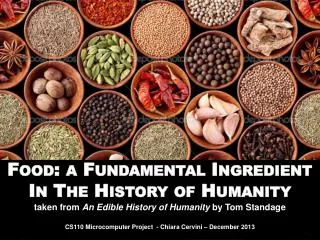
Food: a FundamentalIngredient In The History of Humanitytaken from An Edible History of Humanity by Tom StandageCS110 Microcomputer Project - Chiara Cervini – December 2013
or as a narrative of political, philosophical or technological progress.
It is possible to observe history from another point of view, less conventional maybe, but likewise significant for humanity…
Throughout history, foodhas done more thanjust provide sustenance … … It has acted as a catalyst of social transformationand organizationthrough,
Food’s first transformative role acted as a foundation for entire civilizations.
The adoptionofagriculture made new settled lifestyles possible and set mankind on the path to the modern world.
Fromhunting and gathering to Farming in a continuous way.
First Staple Crops Wheat Millet Maize Barley Rice Potatoes
The staple crops that supported the first civilizations, i.e. barley and wheat in the Near East millet and rice in Asia maize and potatoes in the Americas, were not simply discovered by chance.
Crop Selection The first Genetic Engineers were farmers.
Instead, they emerged through a complex process of co-evolution, as desirable traits were selected and propagated by early farmers.
Political, economic and religious structures of ancient societies were based upon the systems of food production and distribution
Agricultural fertility rituals developed intostate religions
FOOD became a means of …
Food-trade routes acted as international communication networks
Early Geographers compiled the first attempts at world maps