Download
1 / 31
310 likes | 444 Views
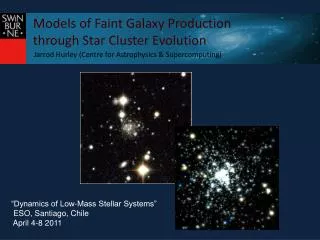
Models of Faint Galaxy Production through Star Cluster Evolution . Jarrod Hurley (Centre for Astrophysics & Supercomputing). “Dynamics of Low-Mass Stellar Systems” ESO, Santiago, Chile April 4-8 2011. Sizes of low-mass stellar systems. Huxor+11.

E N D
Models of Faint Galaxy Production through Star Cluster Evolution Jarrod Hurley (Centre for Astrophysics & Supercomputing) “Dynamics of Low-Mass Stellar Systems” ESO, Santiago, Chile April 4-8 2011
Sizes of low-mass stellar systems Huxor+11 Models of Faint Galaxy Production through Star Cluster Evolution
Sizes of low-mass stellar systems MW M31 Huxor+11 Models of Faint Galaxy Production through Star Cluster Evolution
Sizes of low-mass stellar systems MW M31 M31 dIrr Huxor+11 Models of Faint Galaxy Production through Star Cluster Evolution
Sizes of low-mass stellar systems MW M31 M31 dIrr DM halo Huxor+11 Models of Faint Galaxy Production through Star Cluster Evolution
simulations of low-mass stellar systems in different tidal fields MW M31 M31 dIrr DM halo Huxor+11 Models of Faint Galaxy Production through Star Cluster Evolution
N-body simulation background Equation of Motion O(N3) special-purpose GRAPE hardware GPU [ NBODY4/NBODY6:Aarseth 1999; Aarseth 2003] techniques for few-body subsystems tidal field stellar evolution binary evolution [Hurley et al. 2001] [Mardling & Aarseth 2001; Mikkola 2006, etc.] Models of Faint Galaxy Production through Star Cluster Evolution
Models of Extended Clusters? N = 100,000, 5% binaries, Z = 0.001, KTG IMF, Plummer/King Models of Faint Galaxy Production through Star Cluster Evolution
Models of Extended Clusters? N = 100,000, 5% binaries, Z = 0.001, KTG IMF, Plummer/King RGC = 10 kpc MG = 9x10⁹MsunM = 9x10¹⁰Msun point-mass point-mass or 3-component e.g. NGC6822 e.g. M31 Models of Faint Galaxy Production through Star Cluster Evolution
Models of Extended Clusters? N = 100,000, 5% binaries, Z = 0.001, KTG IMF, Plummer/King e.g. NGC6822 e.g. M31 Models of Faint Galaxy Production through Star Cluster Evolution
Models of Extended Clusters? N = 100,000, 5% binaries, Z = 0.001, KTG IMF, Plummer/King Hurley+Mackey10 Models of Faint Galaxy Production through Star Cluster Evolution
Models of Extended Clusters? Da Costa+09 Models of Faint Galaxy Production through Star Cluster Evolution
Models of Extended Clusters? Da Costa+09 Models of Faint Galaxy Production through Star Cluster Evolution
The N = 200,000 model 200k 2% binaries Rgc = 4 kpc 100k 5% binaries Rgc = 8.5 kpc Models of Faint Galaxy Production through Star Cluster Evolution
Models of Ultra-Faint Dwarfs? 31 127 132 308 170 size/pc 25 64 152 321 554 Strigari+08 sigma ~ 3-10 km/s Models of Faint Galaxy Production through Star Cluster Evolution
Models of Ultra-Faint Dwarfs? MNFW = 109 c = 16 Rgc = 0.5 kpc Models of Faint Galaxy Production through Star Cluster Evolution
Models of Ultra-Faint Dwarfs? MNFW = 109 c = 16 Rgc = 0.5 kpc Models of Faint Galaxy Production through Star Cluster Evolution
Models of Ultra-Faint Dwarfs? MNFW = 109 c = 16 Rgc = 0.5 kpc Models of Faint Galaxy Production through Star Cluster Evolution
Models of Ultra-Faint Dwarfs? MNFW = 109 c = 16 Rgc = 0.5 kpc Models of Faint Galaxy Production through Star Cluster Evolution
Models of Ultra-Faint Dwarfs? Star cluster near centre (Rgc=20pc), MNFW = 108, c=20 N = 100,000, 5% binaries N = 28,000, 40% binaries Models of Faint Galaxy Production through Star Cluster Evolution
Models of Ultra-Faint Dwarfs? Star cluster near centre (Rgc=20pc), MNFW = 108, c=20 N = 100,000, 5% binaries N = 28,000, 40% binaries Models of Faint Galaxy Production through Star Cluster Evolution
Models of Ultra-Faint Dwarfs? Star cluster near centre (Rgc=20pc), MNFW = 108, c=20 N = 100,000, 5% binaries N = 28,000, 40% binaries Models of Faint Galaxy Production through Star Cluster Evolution
Models of Ultra-Faint Dwarfs? Star cluster near centre (Rgc=20pc), MNFW = 108, c=20 N = 100,000, 5% binaries N = 28,000, 40% binaries Models of Faint Galaxy Production through Star Cluster Evolution
Models of Ultra-Faint Dwarfs? Star cluster near centre (Rgc=20pc), MNFW = 108, c=20 N = 100,000, 5% binaries N = 28,000, 40% binaries Models of Faint Galaxy Production through Star Cluster Evolution
Models of Ultra-Faint Dwarfs? Star cluster near centre (Rgc=20pc), MNFW = 108, c=20 N = 100,000, 5% binaries N = 28,000, 40% binaries Sand+10 Leo IV Models of Faint Galaxy Production through Star Cluster Evolution
Models of Ultra-Faint Dwarfs? Star cluster near centre (Rgc=20pc), MNFW = 108, c=20 N = 100,000, 5% binaries N = 28,000, 40% binaries Models of Faint Galaxy Production through Star Cluster Evolution
Models of Ultra-Faint Dwarfs? Star cluster near centre (Rgc=20pc), MNFW = 108, c=20 N = 100,000, 5% binaries N = 28,000, 40% binaries rpl = 27 pc rpl = 15 pc Models of Faint Galaxy Production through Star Cluster Evolution
Models of Ultra-Faint Dwarfs? Star cluster near centre (Rgc=20pc), MNFW = 108, c=20 N = 100,000, 5% binaries N = 28,000, 40% binaries Martin+08 Models of Faint Galaxy Production through Star Cluster Evolution
Models of Ultra-Faint Dwarfs? M300 ~ 0.7x10⁷Msun sigma ~ 5 km/s Models of Faint Galaxy Production through Star Cluster Evolution
Future … • complex tidal fields • definition of tidal radius? • explore initial N, fb, density, sigma … • non-virialprotoclusters, e.g. Hurley+Bekki08 • include gas? • … Models of Faint Galaxy Production through Star Cluster Evolution