Download
1 / 20
200 likes | 355 Views
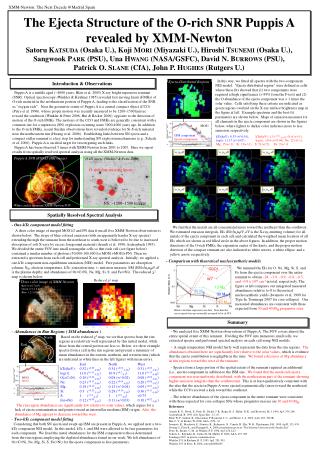
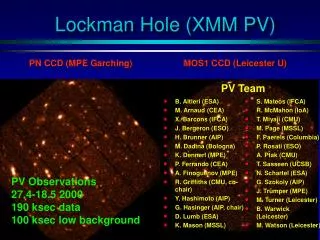
This study presents findings from XMM-Newton observations of the Lockman Hole, covering data from April 27 to May 18, 2000. The analysis reveals significant differences between low-background X-ray emissions from new sources (0.5-10 keV) compared to earlier ROSAT data (0.1-2 keV). Notably, new sources exhibit harder spectra, suggesting an increase in absorbed, intrinsically soft continua, particularly among type-2 AGNs. This work confirms associations with high-redshift clusters and contributes to the understanding of the X-ray background, with important implications for galaxy evolution and AGN studies.

E N D
PV Team • B. Altieri (ESA) • M. Arnaud (CEA) • X. Barcons (IFCA) • J. Bergeron (ESO) • H. Brunner (AIP) • M. Dadina (Bologna) • K. Dennerl (MPE) • P. Ferrando (CEA) • A. Finoguenov (MPE) • R. Griffiths (CMU, co-chair) • Y. Hashimoto (AIP) • G. Hasinger (AIP, chair) • D. Lumb (ESA) • K. Mason (MSSL) • S. Mateos (IFCA) • R. McMahon (IoA) • T. Miyaji (CMU) • M. Page (MSSL) • F. Paerels (Columbia) • P. Rosati (ESO) • A. Ptak (CMU) • T. Sasseen (UCSB) • N. Schartel (ESA) • G. Szokoly (AIP) • J. Trümper (MPE) • M. Turner (Leicester) • B. Warwick (Leicester) • M. Watson (Leicester) Lockman Hole (XMM PV) PN CCD (MPE Garching) MOS1 CCD (Leicester U) PV Observations 27.4-18.5 2000 190 ksec data 100 ksec low background
Colour Image 0.5-0.2 keV 2-4.5 keV4.5-10 keV PN+MOS1+MOS2
Comparison XMM/ROSAT XMM X-ray Colours (0.5-10 keV) ROSAT HRI-PSPC (0.1-2 keV)
logN-logS XMM Chandra Giacconi et al. ROSAT ASCA ROSAT fluctuations. BeppoSAX fluctuations.
Very hard logN-logS (5-10 keV) XMM/BeppoSAX Gilli model
X-ray Diagnostics logNH=23 1 = 0 2 22.5 3 + + + + + + 22 + + New XMM sources are significantly harder than ROSAT sources, but mainly have absorbed, intrinsically soft continua => type-2 AGN !
Kerr Schwarz- schild 6.4 keV restframe 2 Kerr BH Inclination 15o Ri 5 RG Ro 20 RG 1
A surprise ! Inclination=45o Ri unconstrained Ro 20 RG
Keck NIRPEC Thompson et al., 2000 High-redshift cluster
Sample cluster spectra z=1.26 kT=5 keV Constraints on Temperature and abundance possible for very high redshift or low luminosity z=0.26 kT=1.5 keV
z=1.26 z=0.26 Cluster Luminosity/Temperature Relation Borgani, Tozzi, Rosati (2000)
LH Optical/NIR coverage V, I: CFHT 8K < 25.5 mag* R: Keck LRIS < 25 mag K: Calar Alto ‘ < 20 mag** (largest K-band survey at that mag) 30 arcmin *courtesy G. Wilson, IfA **partially courtesy K. Meisenheimer (CADIS)
Optical Identifications K, I, V colour image PSPC HRI 14Z K, I, V colour image 84Z Keck LRIS + NIRC Schmidt et al., 1998; Lehmann et al., 2000
EROs Photometric redshifts Chandra/XMM limit XMM XMM optical IDs fX/fopt=1 fX/fopt=1 spectroscopy limit spectroscopy limit + + + + + + + + AGN type1 AGN type2 Cluster/group Star + unidentified
Photometric Redshifts K H J z I z=1.9 R V z=1.5 z=1.4 poor fit! z=1.2 Courtesy: L. Pozzetti
Colour Segregation Ellipticals AGN type 1 AGN type 2 Cluster/group Star + unidentified + + + Sb-gal. Type 2 AGN show galaxy colours + Photometric z techniques work QSO-2 at high redshift
Hardness vs. Colour HR2 HR1 + + + + + + + + EROs have hard X-ray spectra AGN
NGC 6240 QSO average (Elvis et al.) NGC 6240 QSO-2 Spectra
Summary • ROSAT: first evidence of high-z QSO-2 • XMM PV data substantially deeper than ROSAT • deeper than published Chandra in 2-10 keV band • Giacconi 2-10 keV logN-logS confirmed • New: 5-10 keV logN-logS, consistent with XRB model • high-quality spectral fits for ROSAT sources: unobscured power laws for type-1 AGN, obscured PL for type-2 • tantalizing indication of relativistic disk lines at z=1 • temperature determination of z=1.26 cluster • new XMM sources are preferentially EROs • EROs have hard X-ray spectra, therefore are AGN • so far XMM+Chandra data are fully consistent with obscured AGN XRB model Watch this space !
[NeV] line Large Balmer decrement Chandra obscured AGN => obscured AGN indicators Chandra findings are entirely consistent with the obscured AGN model for the X-ray background Mushotzky et al., 2000