SiD Muon Detector Progress
This document outlines the design and cost estimate for the SiD Muon Strip-Scintillator Detector. It discusses the overall conceptual framework, detailing the integration of orthogonal strip modules into iron slots, and examines key components such as large planar modules, WLS fibers, and photo-detectors. The design emphasizes the need for rigorous testing, assembly, and quality assurance. Additionally, it addresses cost assessment based on material quotes and the importance of effective electronics interface. Contributors to the project are acknowledged for their extensive efforts in advancing the detector technology.

SiD Muon Detector Progress
E N D
Presentation Transcript
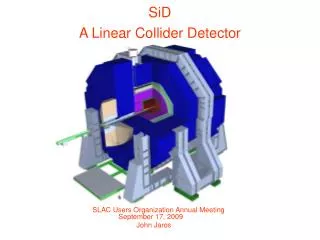
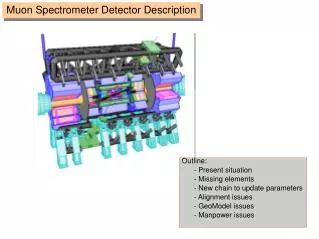
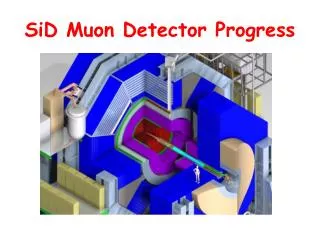
Overall concept There are slots in the iron. We will insert modules of orthogonal strips of appropriate size into the slots. We assume slots are ~32mm and Fe is about 200mm, with 10 slots instrumented.
Detailed Baseline Design • Barrel (z) strip-scintillator 5.5 m long. • (r, f) strips perpendicular to (z) strips. • Large planar modules ~ 5.54m X 3.8m ~ 21m2. • 1.2 mm diameter WLS fiber in extruded hole? • Si avalanche photo-diodes-pixelated photon det. • Significant testing of long strips, but no construction of modules. Production tooling needs to be designed, built and used on proto-types. • Common electronics: KPiX.
Module concept (w/o RO) Sandwich of Al skin (3 layers) Glue (4 layers) Scint (2 layers) X y Thickness is 3.38 cm Detector module detail with dimensions
WLS fiber & photo-detectors • Minimal efforts for SiD, but active efforts for mu2e cosmic ray veto.dAddressing • cost, • “value engineering” • QA • Radiation hardness • Coupling, assembly • Fiber cost based on current quotes for mu2e: 18k ch
Conceptual design for SiPM to fiber coupling Flycut after fiber guide bar is attached to the extrusion Works for either single sided or double sided readout
WLS fiber & photodetectors • No active efforts for SiD, but active efforts for mu2e cosmic ray vetoAddressing • cost, • “value engineering” • QA • Radiation hardness • Coupling, assembly • Cost based on current quotes for mu2e (18k ch)
Electronics • Should not be driven by muon tracker • Large signals • No discharges • KPIX should work fine • Issue is channels are physically spread out • Reduce number of channels used for each chip
Assembly • Thinking about module assembly in some detail • 17 steps (so far) • Measuring strips • Aligning the strips and holes • Doing a dry layup • Installing the fibers • Gluing everything together
WLS Fiber and Strip Scintillator Cost 2003 2012 44.1km WLS fiber 1.2 mm dia. for $252,720. $5.73/m • 5km WLS fiber 1.2 mm dia. for $16,400. $3.28/m 5.73/3.28 = 1.75 2727m 9/15/2003 cost $5.20/m; 3000m 9/2012 cost $26,000 or $8.667/m Strip Scintillator $8.667/$5.20/ =1.665
Strip scintillator 9/15/2003 2,727m from Itasca Plastics at a cost of $5.20/m 9/2012 3,000m $26,000 or $8.667/m
Thanks to Organizers and colleagues! Colleagues who have spent long hours at the Test Beam! And long hours thinking about our problems and their solutions Contributors to this talk: Henry Band Marty Breidenbach Gene Fisk Dave Hedin Kurt Krempetz Giovanni Pauletta Paul Rubinov