Understanding Operator Overloading in C++: Complex Numbers
This document provides an in-depth exploration of operator overloading in C++ using complex numbers as an example. It covers the implementation of binary operators such as addition and subtraction, as well as unary operators like increment and decrement. The text explains how to define and use custom operators in a class, specifically focusing on the `complex` class that represents complex numbers. Additionally, it discusses the significance of operator return types and the challenges of operator overloading, offering insights into proper implementation practices.

Understanding Operator Overloading in C++: Complex Numbers
E N D
Presentation Transcript
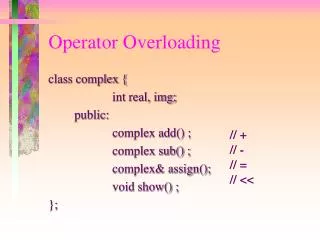
Operator Overloading class complex { int real, img; public: complex add() ; complex sub() ; complex& assign(); void show() ; }; // + // - // = // <<
Operator Overloading main() { complex c1(5,3), c2(2,2) ; c1.assign(c1.add(c2)) ; // c1 = c1 + c2 ; c1.show( ) ; // cout << c1 ; };
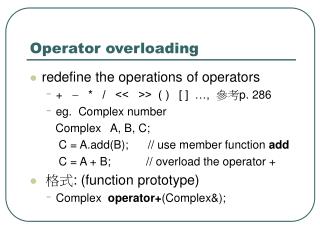
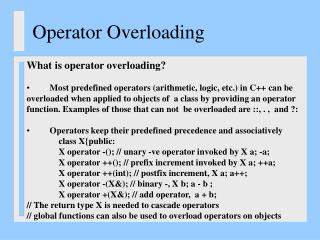
Operator Overloading • Binary Operator • +, -, *, /, …., >, < , >= , <= • Unary Operator • ++, --, +, - • I/O Stream • <<, >> • Type Conversion • char *, float, int
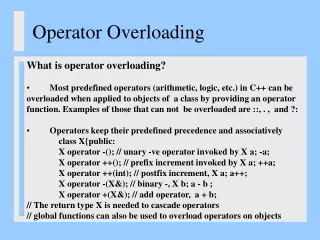
Overloading Binary Operator: operatorX() class complex { int real, img ; public: // constructor complex operator+(const complex&) const ; complex operator=(const complex&) ; complex& operator+=(const complex &); bool operator>(const complex&) ; };
Usage main() { complex a(1,1) ; // a= 1+1i ; complex b(2,2), c ; c = a+b ; a = b = c ; }
How to call operatorX() ? complex operator+(const complex& right) const{….} complex& operator=(const complex& right) const{….} main ( ) { complex c,a, b; …... c = a + b ; } (1) a+b <=> a.operator+(b) (2) a = b <=> a.operator=(b)
operator+ // left + right complex complex::operator+(const complex& right) { complex temp ; temp.real = real+right.real ; templ.img = img+right.img; return temp; }; Q: How many Objects generated here? why?
Insight the operator+() Q: why can’t we return a reference from operator+? complex & complex::operator+(const complex&right) { complex temp; temp.real = real+right.real; temp.img = img+right+img ; return temp ; }
Insight operator+() // (續上) complex operator+(const complex& right) const { return complex(real+right.real,img+right.img); } • Why not void operator+( ) ? a+b+c <=> o1 = a.operator+(b)); o2 = o1.operator+(c)
operator= complex& complex::operator=(const complex&right) { real = right.real; img = right.img; return *this; } main() { complex a(2,2), b=a, c; c = b ; // c.operator=(b) ; } Q1: what’s this about *this ; Q2: Why complex& can(should) be used here? Q3: Compare with copy constructor.
Proper Return Type class complex { int real, img ; public: // constructor complex operator+(const complex&) const ; complex& operator=(const complex&) ; complex operator+=(const complex &); bool operator>(const complex&) ; };
Overload Unary Operator: ++, --, +, - // Overloading ++ // a) prefix version complex& operator++() {real++; img++; return *this} // b) postfix version complex& operator++(int) {real++; img++; return *this;} …... main() { complex a(1,1), b(2,2) ; a++; ++b ; }
Overload Unary Operator • what’s the proper return type of ++ ? • void (no return value needed) • complex ( by value) • complex & (by reference) • how to override subtraction and negative ? • (-) • what’s the proper return type?
Overload index operator [] class safe_arr{ private: const int szie ; int *arr ; public: int_arr(int n):size(n){ arr = new int[n] ;} int& operator[](int index); ~int_arr() {….} }
operator[] // why the return type: int& int& safe_arr::operator[] (int index) { ????? } main() { safe_arr a(10) ; int b ; b = a[3]; a[5] = 7 ; }|
operator[] int& safe_arr::operator[] (int index) { if (n <0 || n >= size) { cout << “index out of range” ; exit(1) ; return arr[index] ; } main() { safe_arr a(10) ; int b ; b = a[3]; a[5] = 7 ; }| // b = a.operator[](3) ; // a.operator[](5) = 7;
Discussions • You can’t overloading anying • +, -, *, /, =, >, <, [], new, delete… OK! • not-existing operator(say **, $) not OK! • special built-in operator . :: ?: not OK!
Discussions complex operator+(const complex& right) const return type (by value) parameter (constant reference) function-style (const)
Discussions operators return-type parameter fun-style arithmetic(+,-,*,/) value const ref const assignment(=,+=,-=) ref(*this) const ref non-const comparison(>,<…) value(bool) const ref const prefix-unary(++,--) ref(*this) - non-const post-unary(++,--) ref(*this) int(useless) non-const sign-unary(+,-) value - const index([]) ref integer non-const
Discussions When design a class, what kind of member-functions needed? (1) constructor (2) destructor (3) Object I/O: (4) operator = (above are necessary ) (5) others: +, - ,….
Type Conversion of User-defined Classes • built-in explicit conversion int total, cnt; float avg ; ….. avg = (float)total/cnt; avg = float(total)/cnt; avg =static_cast<float>(total)/cnt;
Type Conversion of User-defined Classes • built-in implicit conversion int a=1, b=2, c = 3; float x(a) ;// x(a), x = float(a) a = b ; x = c ; // x = float(c)
User-defined Class toBuilt-in data type EX1: Complex class complex { float real, img ; public: operator float() {return sqrt(real*real+img*img);} }; no return type needed main() { complex a(1,1) ; float norm ; norm = float(a) ; // explicit norm = a; // implicit }