Download
1 / 17
170 likes | 296 Views
This overview of experimental design outlines foundational concepts such as dependent and independent variables, confounding variables, and functional relationships. It explains various design methodologies including the Single Subject Design, A-B and ABA Reversal Designs, Multiple Baseline Design, Multielement Design, and Changing Criterion Design. Each method's advantages and limitations are discussed, highlighting how to effectively demonstrate experimental control and address issues like ethical considerations and sequence effects. These insights are critical for researchers aiming to understand behavior through empirical studies.

E N D
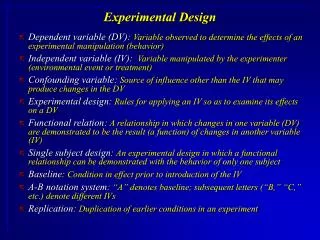
Experimental Design • Dependent variable (DV): Variable observed to determine the effects of an experimental manipulation (behavior) • Independent variable (IV): Variable manipulated by the experimenter (environmental event or treatment) • Confounding variable: Source of influence other than the IV that may produce changes in the DV • Experimental design: Rules for applying an IV so as to examine its effects on a DV • Functional relation: A relationship in which changes in one variable (DV) are demonstrated to be the result (a function) of changes in another variable (IV) • Single subject design: An experimental design in which a functional relationship can be demonstrated with the behavior of only one subject • Baseline: Condition in effect prior to introduction of the IV • A-B notation system: “A” denotes baseline; subsequent letters (“B,” “C,” etc.) denote different IVs • Replication: Duplication of earlier conditions in an experiment
A-B Design Definition: Single introduction of at least one IV on at least one baseline
A-B Design • Definition: Single introduction of at least one IV on at least one baseline • Advantage: Repeated measurement under BL (A) and Rx (B) conditions allows examination of changes in level, trend, and variability • Limitations: • No replication • Therefore, does not rule out the influence of confounding variables • Therefore, no demonstration of a functional relation
Reversal Design (ABA) Definition: Introduction and subsequent removal of at least one IV on one BL
Reversal Design • Definition: Introduction and subsequent removal of at least one IV on one BL • Variations: ABAB, ABA, BAB, ABAC, etc. • Advantage: Simple yet powerful demonstration of experimental control
Reversal Design • Definition: Introduction and subsequent removal of at least one IV on one BL • Variations: ABAB, ABA, BAB, ABAC, etc. • Advantage: Simple yet powerful demonstration of experimental control • Limitations: • Detrimental effects of reversal: Ethical considerations • Irreversibility: Failure to reproduce effect observed in a previous phase even though conditions are arranged identically • Sequence/Order effect: Influence of a previous manipulation on responding in a later condition (e.g., training contingencies)
Multiple Baseline Design Definition: Sequential introduction of an IV across more than one BL
Multiple Baseline Design • Definition: Sequential introduction of an IV across more than one BL • Variations: Across subjects, behaviors, settings • Advantage: Does not require reversal to show experimental control • Disadvantages: • Stability requirement more cumbersome than with a reversal design • Potential generalization across baselines (more likely with MBL across behaviors or settings)
Multielement Design Definition: Rapid alternation of BL and IV conditions (or 2 or more IVs) on a single BL
Multielement Design(aka Alternating Treatments) • Definition: Rapid alternation of BL and IV conditions (or 2 or more IVs) on a single BL • Variations: BL vs. Rx, Rx1 vs. Rx2 (with or without BL), etc. • Advantages: • Does not require baseline (although preferred) • Accommodates trends and instability • Minimizes sequence effects (limited exposure to one condition) • Ideally suited to complex analyses (parametric, component, comparative) • Limitation: Multiple treatment interference
Changing Criterion Design Definition: Introduction of one IV on a single BL in step-wise fashion, with steps corresponding to progressive changes in either response requirement or value of the IV
Changing Criterion Design • Definition: Introduction of one IV on a single BL in step-wise fashion, with steps corresponding to progressive changes in either response requirement or value of the IV • Advantage: No reversal and no additional baselines required to show experimental control • Disadvantages: • Requires control over both direction and level of change • Requires careful selection of criterion change