Download
1 / 11
110 likes | 242 Views
This chapter explores the concept of statistical significance, emphasizing the distinction between systematic influences and chance in research outcomes. It covers the significance level and its relation to Type I and Type II errors, defined by alpha (α) and beta (β) levels respectively. The text highlights that while a finding can be statistically significant, it may not always be meaningful. Researchers are encouraged to consider effect size and the implications of their findings, ensuring that statistical significance is not the sole focus of scientific inquiry.

E N D
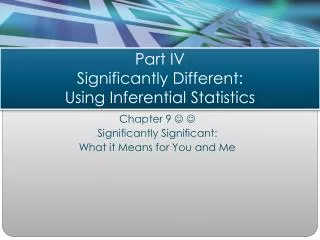
Part IVSignificantly Different:Using Inferential Statistics Chapter 9 Significantly Significant: What it Means for You and Me
The Concept of Significance • Any difference between groups that is due to a systematic influence rather than chance • Must assume that all other factors that might contribute to differences are controlled
If Only We Were Perfect… • Significance level • The risk associated with not being absolutely sure that what occurred in the experiment is a result of what you did or what is being tested • The goal is to eliminate competing reasons for differences as much as possible. • Statistical Significance • The degree of risk you are willing to take that you will reject a null hypothesis when it is actually true.
Type I Errors (Level of Significance) • The probability of rejecting a null hypothesis when it is true • Represented by alpha () • Conventional levels are set between .01 and .05 • Choice of alpha often depends on the consequences of being wrong
Type II Errors • The probability of accepting a null hypothesis when it is false • Referred to as “Beta” • Represented by β • Power = 1- β
Significance Versus Meaningfulness • A finding can be statistically significant but not very meaningful • A finding can be statistically significant but not “big enough” • Statistical significance should not be the only goal of scientific research • Effect Size • Significance is influenced by sample size and variability…we’ll talk more about this later.
How Inference Works • A representative sample of the population is chosen. • Data is collected, a mean (or means) are computed and compared to population means (real or hypothesized) • A conclusion is reached as to whether the mean is statistically significant (i.e. different from the population mean) • Based on the results of the sample, an inference is made about the population.
Tests of Significance – A General Process 1. A statement of the null hypothesis. 2. Set the level of risk associated with the null hypothesis. (alpha) 3. Select the appropriate test statistic. 4. Compute the test statistic (obtained) value 5. Determine the value needed to reject the null hypothesis using the appropriate table of critical values 6. Compare the obtained value to the critical value 7. If obtained value is more extreme, reject the null hypothesis 8. If obtained value is not more extreme, accept the null hypothesis