Download
1 / 79
790 likes | 929 Views
Discover the significance of primary sources in education through MeL (Michigan Electronic Library) resources. This training, led by Suzanne Robinson, encourages educators to incorporate diverse formats such as comics, manuscripts, and interviews to engage students and foster higher-level thinking skills. By utilizing hands-on materials, learners can connect with subjects, develop analytical abilities, and gain firsthand knowledge. Discover where to find these valuable resources in MeL, such as MeLMichigana, Sabin Michigan collection, and more.

E N D
MAME 2010 • Lansing, MI • Suzanne Robinson, MeL Databases Training Coordinator, MCLS
MeL Credits • MeL is a project of the Library of Michigan, an agency of the state government. The Library of Michigan contracts with MCLS and partners with a number of Michigan organizations and institutions to provide MeL services. • This service is funded in part by the State of Michigan through the Library of Michigan.Additional project support comes from the Federal Library Services and Technology Act (LSTA) via the Institute of Museum and Library Services(IMLS).
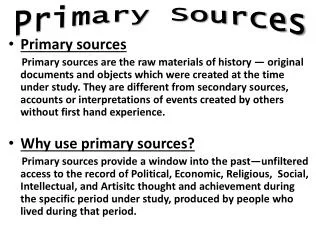
Whyuse primary sources? • Spice things up • Bring subjects to life • Better understanding
Engage students • Develop higher level thinking skills • Learn new ways to apply knowledge
Recognizing • Assume “from the time period” • Firsthand knowledge or reporting • Not retrospective
What are primary sources? • Comic books & graphic novels • Manuscripts • Archival materials • Realia • Books • Pamphlets • Essays • Diaries • Serials • Gov docs • Maps
Tablets • Visual materials • Music, sheet music • Sound recordings • Dissertations • Interviews • Emails • Tweets • Text messages • Census data
What kinds of formats? • Original • Microform • Digitized • Scanned or ASCII text
What are secondary sources? • Secondhand knowledge • After the event with analysis, interpretation,etc. • Conveying experiences and/or opinions of others • One step removed
I.E., many sources reviewed, analyzed, different viewpoints taken into account, third party accounts, newspaper reports, etc.
What to ask • How does the author know? • Was the author at the scene? • Where does the information come from? • Based on single piece of evidence or multiple sources?
Where in MeL? • MeLMichigana • Sabin Michigan collection • Academic OneFile • Opposing Viewpoints • Gale Virtual Ref Library • eLibrary, eLib Elem • Culturegrams
OAIster • MeLCat • Worldcat.org • Library of Congress