Key Milestones in Computing, Biology, and Engineering Innovations
Explore groundbreaking concepts and milestones in computing, biology, and engineering that have shaped modern technology. Discover Charles Babbage's pioneering work on programmable computers, the significance of the first cloned mammal, Dolly the Sheep, and innovations like the artificial heart and Mag-lev trains. Learn about crucial developments in programming languages, the principles of bioinformatics, and cutting-edge propulsion systems. Delve into the achievements of visionaries like Thomas Edison and R. Buckminster Fuller, who significantly influenced their fields.

Key Milestones in Computing, Biology, and Engineering Innovations
E N D
Presentation Transcript
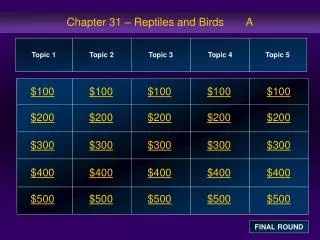
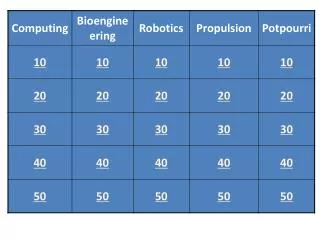
Topic 1: 10 This man originated the concept of a programmable computer. Charles Babbage
Topic 1: 20 A terabyte is how many bytes? 1TB = 1012 bytes
Topic 1: 30 In a traditional first program many people learn, this two word phrase is output on a display device. A “Hello World” program
Topic 1: 40 The name for this programming language literally means an increment on its predecessor, which reflects it’s evolutionary nature. C++
Topic 1: 50 This law, coined around 1970 by one of Intel’s founders, claims that the number of transistors on integrated circuits double every two years. Moore’s Law
Topic 2: 10 When this sheep was born in 1996, she became the first successfully cloned mammal. Dolly the Sheep
Topic 2: 20 This interdisciplinary field addresses biological problems using computational techniques, and makes the rapid organization as well as analysis of biological data possible. Bioinfomatics
Topic 2: 30 What method uses an electric field passed through a gel to separate DNA, RNA and proteins based on their size and charge? Gel electrophoresis
Topic 2: 40 This field uses the knowledge gained from reverse engineering evolved living systems to solve difficult design problems in artificial systems. Biomemetics
Topic 2: 50 Robert Jarvik invented this biomedical device that was first successfully used in 1982. Since then, variations have been used as a bridge for organ transplantation. Artificial Heart
Topic 3: 10 This Czech author and playwright coined the term “robot” in his play “RUR”. Karel Čapek
Topic 3: 20 What is the name of the first dexterous humanoid robot in space? Robonaut 2
Topic 3: 30 This is a measure of a robot’s independence. Autonomy
Topic 3: 40 This type of actuator moves in and out and is used in industrial robotics when very large forces are needed. Linear Actuator
Topic 3: 50 This is the science of machines that see. Computer Vision
Topic 4: 10 This propulsion system has no moving parts and operated at hypersonic velocities. Scramjet
Topic 4: 20 Who constructed the first practical four-stroke internal combustion engine? Nicolas Augustus Otto
Topic 4: 30 The fastest trains in the world use this type of propulsion. Mag-lev (or Magnetic Levitation)
Topic 4: 40 In 1957, this German engineer invented a rotary engine that has been used in a variety of vehicles such as automobiles, motorcycles, aircraft and jet skis. Felix Wankel
Topic 4: 50 In this type of rocket, the oxidier is kept separate from the fuel. Hybrid
Topic 5: 10 What two organizations joined to form AIAA in 1963? American Rocket Society (ARS) and the Institute of the Aeronautics Sciences (IAS)
Topic 5: 20 Name this number sequence: 0, 1, 1, 2, 3, 5, 8, 13, … Fibonacci sequence
Topic 5: 30 The concept of a simple machine originated with this Greek philosopher. Archimedes
Topic 5: 40 He was dubbed the “Wizard of Menlo Park” and held over 1,000 patents. Thomas Edison
Topic 5: 50 This man is best known for his geodesic dome design for which he received a patent for in 1954. R. Buckminster Fuller