Download
1 / 9
90 likes | 107 Views
Explore the foundations of atomic theory, including the law of conservation of mass, law of definite proportions, and law of multiple proportions. Learn about Dalton's atomic theory and its relationship to these laws. Discover how modern atomic theory has expanded our understanding of atoms.

E N D
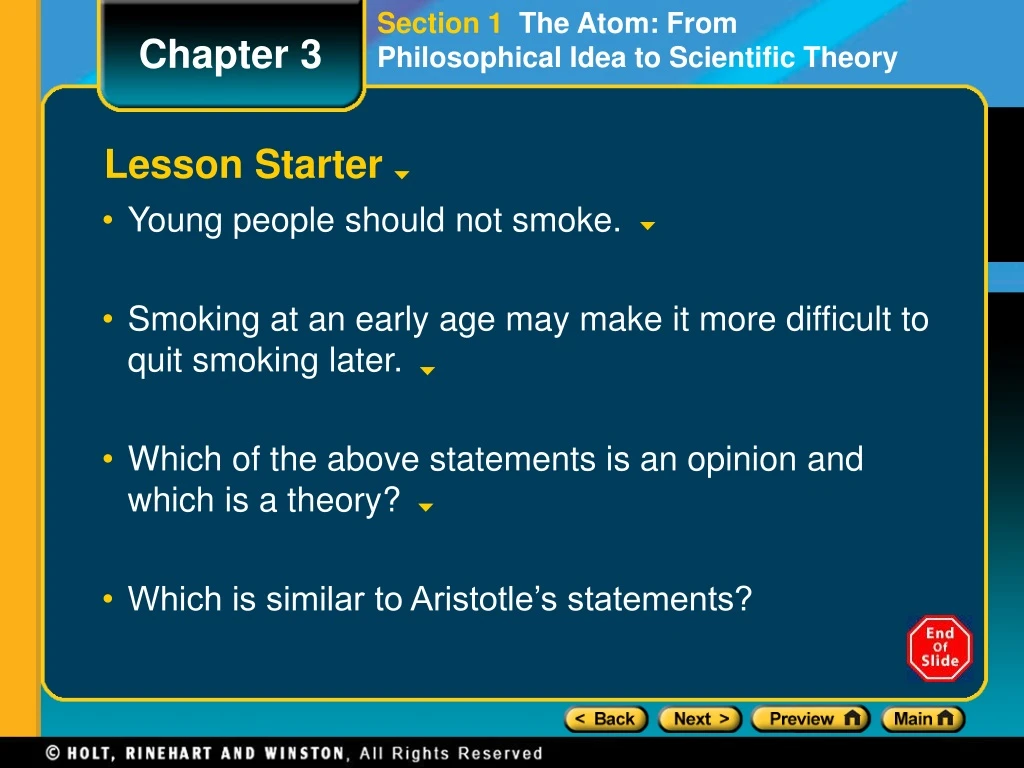
Section 1 The Atom: From Philosophical Idea to Scientific Theory Chapter 3 Lesson Starter • Young people should not smoke. • Smoking at an early age may make it more difficult to quit smoking later. • Which of the above statements is an opinion and which is a theory? • Which is similar to Aristotle’s statements?
Section 1 The Atom: From Philosophical Idea to Scientific Theory Chapter 3 Objectives • Explain the law of conservation of mass, the law of definite proportions, and the law of multiple proportions. • Summarize the five essential points of Dalton’s atomic theory. • Explain the relationship between Dalton’s atomic theory and the law of conservation of mass, the law of definite proportions, and the law of multiple proportions.
Section 1 The Atom: From Philosophical Idea to Scientific Theory Chapter 3 Foundations of Atomic Theory • The transformation of a substance or substances into one or more new substances is known as a chemical reaction. • Law of conservation of mass:mass is neither created nor destroyed during ordinary chemical reactions or physical changes
Section 1 The Atom: From Philosophical Idea to Scientific Theory Chapter 3 Foundations of Atomic Theory, continued • Law of definite proportions: a chemical compound contains the same elements in exactly the same proportions by mass regardless of the size of the sample or source of the compound • Law of multiple proportions: if two or more different compounds are composed of the same two elements, then the ratio of the masses of the second element combined with a certain mass of the first element is always a ratio of small whole numbers
Section 1 The Atom: From Philosophical Idea to Scientific Theory Chapter 3 Law of Conservation of Mass
Section 1 The Atom: From Philosophical Idea to Scientific Theory Chapter 3 Law of Multiple Proportions
Section 1 The Atom: From Philosophical Idea to Scientific Theory Chapter 3 Dalton’s Atomic Theory • All matter is composed of extremely small particles called atoms. • Atoms of a given element are identical in size, mass, and other properties; atoms of different elements differ in size, mass, and other properties. • Atoms cannot be subdivided, created, or destroyed.
Section 1 The Atom: From Philosophical Idea to Scientific Theory Chapter 3 Dalton’s Atomic Theory, continued • Atoms of different elements combine in simple whole-number ratios to form chemical compounds. • In chemical reactions, atoms are combined, separated, or rearranged.
Section 1 The Atom: From Philosophical Idea to Scientific Theory Chapter 3 Modern Atomic Theory • Not all aspects of Dalton’s atomic theory have proven to be correct. We now know that: • Atoms are divisible into even smaller particles. • A given element can have atoms with different masses. • Some important concepts remain unchanged. • All matter is composed of atoms. • Atoms of any one element differ in properties from atoms of another element.