Mastering Scientific Measurement and Notation Techniques
380 likes | 399 Views
Learn how to use and express measurements using scientific notation, understand accuracy, precision, and error, apply significant figures, rounding, units of measurement, and solve conversion problems effectively.


Mastering Scientific Measurement and Notation Techniques
E N D
Presentation Transcript
3.1 Using and Expressing Measurements • Measurements have quantity and unit
Scientific Notation • Scientific notation: useful for very large or very small numbers • 1 g of hydrogen contains 602,000,000,000,000,000,000,000 hydrogen atoms (or 6.02 x 10²³ hydrogen atoms) • 1 atom of gold has a mass of 0.000000000000000000000327 g (or 3.27 x 10⁻²² g)
Scientific Notation • For adding and subtracting, the exponents must be the same before the coefficients can be added or subtracted • To multiply numbers written in scientific notation: multiply coefficients and add the exponents • (2 x 104) x (6 x 101) = (2 x 6) x 104+1 = 12 x 105 =1.2 x 10⁶ • To divide: divide coefficients and subtract the denominator exponent from the numerator exponent
Practice • Solve and express the answer in scientific notation • (4.0 x 103) x (2.0 x 10-5) • (8.0 x 10-2) x (7.0 x 10-5) • (8.0 x 10³) ÷ (4.0 x 10³) • (6.0 x 10⁴) ÷ (3.0 x 10⁻³) • (7.1 x 10⁻²) + (5x 10⁻³) • (2.7 x 10³) + (4.0 x 10²) • (9.4 x 10⁷) − (4.3 x 10⁷) • (3.5 x 10¹³) − (4 x 10¹²)
Practice • Solve and express the answer in scientific notation • (4.0 x 103) x (2.0 x 10-5)= 8.0 x 10⁻² • (8.0 x 10-2) x (7.0 x 10-5)= 5.6 x 10⁻⁶ • (8.0 x 10³) ÷ (4.0 x 10³)= 2.0 x 100 • (6.0 x 10⁴) ÷ (3.0 x 10⁻³)= 2.0 x 10⁷ • (7.1 x 10⁻²) + (5x 10⁻³)= 7.6 x 10⁻² • (2.7 x 10³) + (4.0 x 10²)= 3.1 x 10³ • (9.4 x 10⁷) − (4.3 x 10⁷)= 5.1 x 10⁷ • (3.5 x 10¹³) − (4 x 10¹²)= 3.1 x 10¹³
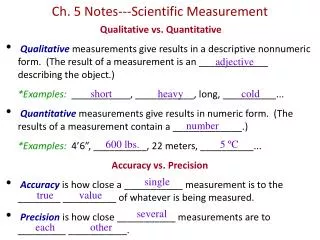
Accuracy, Precision, and Error • Accuracy: close to true value • Precision: close to each other
Accuracy, Precision, and Error • Error: difference between experimental value and the true(accepted) value • Experimental value – true value • Percent error: x 100%
Significant Figures (Sig. Fig’s) • Use to represent how certain we can be of a measurement • Last digit is estimated • Limited by the precision of the measuring tool • If measuring to 1 mL certainty, you can’t know to 0.001 mL • If measuring to 100 mL certainty, can’t know to 1 mL • If calculating, can only know to the least certain measurement
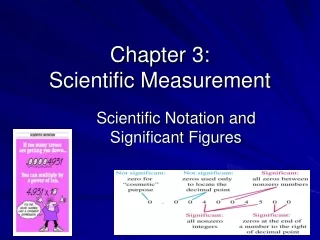
Significant Figures • Any non-zero digit is significant • Zeros between non-zero digits are significant • Zeros to the left of the first non-zero digit are not significant • All zeros to the right of both a decimal point and a non-zero number are significant • For numbers that do not contain decimal points, trailing zeros are not significant (unless counting whole objects or using an accepted conversion factor)
Practice Sig. Fig’s • How many sig. fig’s are in each of the following? • 0.05730 m • 8765 m • 0.00073 m • 40.007 m • 98.473 L • 0.00076321 cg • 57.048 m • 12.170 mL • 0.00749830 x 104 mm • 5200 g • 5.200 x 10⁴dL
Practice Sig. Fig’s • How many sig. fig’s are in each of the following? • 0.05730 m 4 • 8765 m 4 • 0.00073 m 2 • 40.007 m 5 • 8.47 L 3 • 0.00076321 cg 5 • 7.048 m 4 • 12.170 mL 5 • 0.00749830 x 104 mm6 • 5200 g 2 • 5.200 x 10⁴dL4
Rounding • When adding or subtracting, round to fewestdecimal places in given measurements • When multiplying or dividing, round to fewest significant figures in given measurements • Avoid rounding errors! Wait until the end of a multi-step problem to round. Until then, use as many digits as you are given.
Practice Sig. Fig’s with Rounding • Round each of the following answers correctly. • 8.7 g + 15.43 g + 19 g = 43.13 g • 4.32 cm x 1.7 cm = 7.344 cm2 • 853.2 L – 627.443 L = 225.757 L • 38.742 m2 ÷ 0.421 m = 92.02375 m • 5.40 m x 3.21 m x 1.871 m = 32.431914 m3 • 5.47 m3 + 11 m3 + 87.300 m3 = 103.770 m3
Practice Sig. Fig’s with Rounding • Round each of the following answers correctly. • 8.7 g + 15.43 g + 19 g = 43.13g • 4.32 cm x 1.7 cm = 7.344cm2 • 853.2 L – 627.443 L = 225.757L = 225.8 L • 38.742 m2 ÷ 0.421 m = 92.02375m • 5.40 m x 3.21 m x 1.871 m = 32.431914m3 • 5.47 m3 + 11 m3 + 87.300 m3 = 103.770m3 = 104 m3
3.2 Units of Measurement • SI Base Units • Length: meter (m) • Mass: kilogram (kg) • Temperature: kelvin (K) • Time: second (s) • Amount of substance: mole (mol) • Luminous intensity: candela (cd) • Electric current: ampere (A)
Temperature Scales Temperature: measure of the average kinetic energy of particle motion
Density • Ratio of mass of an object to its volume • D=m/v • Intensive property
3.3 Solving Conversion Problems • Conversion Factors: ratio of equivalent measurements; changes numerical value but not actual quantity measured • 100 cm / 1 m • 12 inches / 1 foot • 6.022 × 10²³ particles / 1 mol • Changes numerical value, but not actual quantity • Come in pairs • 1000 g / 1 kg and 1 kg / 1000 g
What conversion factors are necessary for the following problems? • How many seconds are there in an 8-hour workday? • How many minutes are there in one week? • How many seconds are in a 40-hour work week?
Dimensional Analysis • A way to analyze and solve problems using the units (dimensions) of the measurements • Useful for unit conversions • Especially useful for multistep problems • AKA factor-label method
Solve the following problems using dimensional analysis. 1. How many seconds are in a 47-hour work week? 2. An experiment requires each student use a 3.1 cm length of magnesium ribbon. How many students can do the experiment if there is a 104 cm length of magnesium ribbon available? 3. An atom of gold has a mass of 3.271 x 10⁻²² g. How many atoms of gold are in 8.921 g of gold?
Solve the following problems using dimensional analysis. 1. How many seconds are in a 47-hour work week? 47 hr x x = 169,200 s = 1.7 x 10⁵ s 2. An experiment requires each student use a 3.1 cm length of magnesium ribbon. How many students can do the experiment if there is a 104 cm length of magnesium ribbon available? 104 cm x = 33.5 students 33 students 3. An atom of gold has a mass of 3.271 x 10⁻²² g. How many atoms of gold are in 8.921 g of gold? 8.921 g x = 2.727 x 10²² atoms
Solve the following problems using dimensional analysis. 4. Convert 0.0453 km to meters. 5. Convert 52.9 mL to liters. 6. Convert 0.0649 g to centigrams. 7. Convert 152869.4 g to megagrams.
Solve the following problems using dimensional analysis. 4. Convert 0.0453 km to meters. 0.0453 km x = 45.3 m 5. Convert 52.9 mL to liters. 52.9 mL x =0.0529 L 6. Convert 0.0649 g to centigrams. 0.0649 g x = 6.49 cg 7. Convert 152869.4 g to megagrams. 152869.4 g x = 0.1528694 Mg
Dimensional Analysis Activity • Each group will get a segment of the Cardinals’ roster. Please write on a separate page, not on the roster. • Convert heights from feet and inches to meters (2.54 cm = 1 inch). • Convert weights in pounds to masses in kilograms (454 g = 1 lb).
Solve the following problems using dimensional analysis. 8. Convert 291.4 cm3to liters. 9. Convert 53.6 g of boron to cm3of boron. The density of boron is 2.34 g/cm3. 10. Convert 45.38 cm3of boron to grams of boron.
Solve the following problems using dimensional analysis. 8. Convert 291.4 cm3to liters. 291.4 cm3x x = 0.2914 L 9. Convert 53.6 g of boron to cm3of boron. The density of boron is 2.34 g/cm3. 53.6 g boron x =22.9 cm3 boron 10. Convert 45.38 cm3of boron to grams of boron. 45.38cm3 boron x = 106 g boron
Solve the following problems using dimensional analysis. 11. What is the mass, in grams, of a sample of cough syrup that has a volume of 50.0 cm3? The density of cough syrup is 0.950 g/cm3. 12. The radius of a particular atom is 0.573 nm. Express this in cm. 13. The diameter of Earth is 1.3 x 10⁴ km. What is this diameter expressed in mm? In Mm?
11. What is the mass, in grams, of a sample of cough syrup that has a volume of 50.0 cm3? The density of cough syrup is 0.950 g/cm3. 50.0 cm3 cough syrup x = 47.5 g coughsyr. 12. The radius of a particular atom is 0.573 nm. Express this in cm. 0.573 nm x x = 5.73 x 10⁻⁸ cm 13. The diameter of Earth is 1.3 x 10⁴ km. What is this diameter expressed in mm? In Mm? 1.3 x 10⁴km x x = 1.3 x 1010 mm 1.3 x 10⁴ km x x = 1.3 x 101 Mm
Solve the following problems using dimensional analysis. 14. Gold has a density of 19.3 g/cm3. What is the density in kilograms per cubic meter? 15. There are 7.0 × 10⁶ red blood cells in 1.0 mm3 of blood. How many red blood cells are in 1.0 L of blood?
Solve the following problems using dimensional analysis. 14. Gold has a density of 19.3 g/cm3. What is the density in kilograms per cubic meter? 19.3 x x = 1.93 x 10⁴ kg/m3 15. There are 7.0 × 10⁶ red blood cells in 1.0 mm3 of blood. How many red blood cells are in 1.0 L of blood? 1.0 L x x = 7.0 x cells