Advanced Local Alignment Techniques for Genome Comparison and Evolutionary Analysis
This document explores innovative methods for local sequence alignment in genomics, focusing on index-based approaches and chaining strategies to enhance the detection of local alignments between genomes. It investigates the application of evolutionary trees for progressive alignment, utilizing weighted profiles to generate new alignments, and presents statistical methods for finding conserved genomic elements. The discussion includes algorithms like the binomial method, parsimony scoring, and GERP to analyze mutation rates and evolutionary conservation across different species.


Advanced Local Alignment Techniques for Genome Comparison and Evolutionary Analysis
E N D
Presentation Transcript
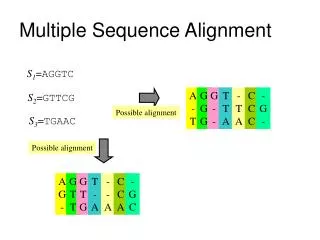
Index-based local alignment …… Dictionary: All words of length k (~10) Alignment initiated between words of alignment score T (typically T = k) Alignment: Ungapped extensions until score below statistical threshold Output: All local alignments with score > statistical threshold query …… scan DB query Question: Using an idea from overlap detection, better way to find all local alignments between two genomes?
Chaining local alignments • Find local alignments • Chain -O(NlogN) L.I.S. • Restricted DP
Progressive Alignment x • When evolutionary tree is known: • Align closest first, in the order of the tree • In each step, align two sequences x, y, or profiles px, py, to generate a new alignment with associated profile presult Weighted version: • Tree edges have weights, proportional to the divergence in that edge • New profile is a weighted average of two old profiles y z Example Profile: (A, C, G, T, -) px = (0.8, 0.2, 0, 0, 0) py = (0.6, 0, 0, 0, 0.4) s(px, py) = 0.8*0.6*s(A, A) + 0.2*0.6*s(C, A) + 0.8*0.4*s(A, -) + 0.2*0.4*s(C, -) Result:pxy= (0.7, 0.1, 0, 0, 0.2) s(px, -) = 0.8*1.0*s(A, -) + 0.2*1.0*s(C, -) Result:px-= (0.4, 0.1, 0, 0, 0.5) w
Threaded Blockset Aligner HMR – CD Restricted Area Profile Alignment Human–Cow
Reconstructing the Ancestral Mammalian Genome Human: C C Baboon: C C Dog: G C or G Cat: C
Finding Conserved Elements (1) • Binomial method • 25-bp window in the human genome • Binomial distribution of k matches in N bases given the neutral probability of substitution
Finding Conserved Elements (2) A C • Parsimony Method • Count minimum # of mutations explaining each column • Assign a probability to this parsimony score given neutral model • Multiply probabilities across 25-bp window of human genome A A G
Phylo HMMs HMM Phylogenetic Tree Model Phylo HMM
Statistical Power to Detect Constraint N L C: cutoff # mutations D: neutral mutation rate : constraint mutation rate relative to neutral
Statistical Power to Detect Constraint N L C: cutoff # mutations D: neutral mutation rate : constraint mutation rate relative to neutral