Understanding Convex Mirrors: Principles, Image Formation, and Applications
This text explores the principles of convex mirrors, specifically their shape and light reflection behavior. It explains how rays parallel to the principal axis reflect through the focal point, resulting in a virtual image that is smaller and upright. By using ray diagrams, we demonstrate how different light paths interact with the mirror. Additionally, we discuss practical applications of convex mirrors, such as in security, cameras, and side-view mirrors, enhancing the user's ability to capture images accurately.

Understanding Convex Mirrors: Principles, Image Formation, and Applications
E N D
Presentation Transcript
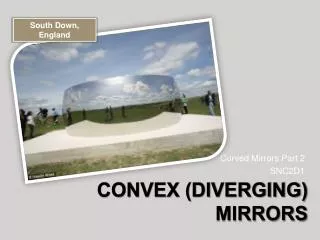
South Down, England Curved Mirrors Part 2 SNC2D1 Convex (diverging) Mirrors
prinicpalaxis Convex Mirrors(curved out) • F • C Light rays that come in parallel to the principal axis reflect from the focal point The focal point is considered virtual since light rays are unable to go through it.
prinicpalaxis Convex Mirrors(curved out) • F • C Light ray aimed at the focal point is reflected parallel to the principal axis.
prinicpalaxis Convex Mirrors(curved out) • F • C Light rays that go through the centre reflect back along the same path.
Locating the Image using Ray diagrams 1. A ray parallel to principal axis will reflect through F 2. A ray aimed at F is reflected parallel to the principal axis 3. A ray through C will reflect back upon itself
principal axis Convex Mirror(example) 1 1 2 2 • V • F • C The first ray comes in parallel to the principal axis and reflects through the focal point. The second ray comes through the focal point and reflects parallel to the principal axis. The light rays don’t converge, so the image is virtual.
Images in convex mirrors Smaller, upright, behind the mirror and virtual image Uses of convex mirrors Security mirrors Camera phones Side-view mirrors Allows the user to correctly take a self-portrait