Convex Combinations
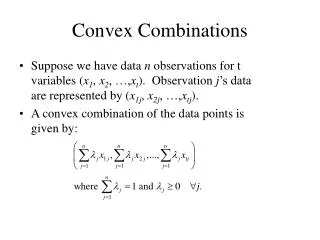
This text explores the concept of convex combinations in the context of multivariate data analysis. Given n observations for t variables, each observation is represented by a t-dimensional vector. A convex combination of these data points is defined, emphasizing the requirements that weights (γ) cannot be negative and must sum to one. This framework allows for the synthesis of different data points through weighted averages, enabling useful applications in statistical modeling and analysis. Examples include combinations of two, three, and five points, as well as the idea of radial expansion.

Convex Combinations
E N D
Presentation Transcript
Convex Combinations • Suppose we have data n observations for t variables (x1, x2, …,xt). Observation j’s data are represented by (x1j, x2j, …,xtj). • A convex combination of the data points is given by:
Notes • The γ cannot be negative. • The sum of the γ must equal 1. • γj represents the weight placed on data point j. • The same γjis applied to all variables.