Hints for Stating Hypotheses
This guide introduces the fundamental concepts of hypothesis construction in research. A hypothesis serves as a testable statement about the relationship between two or more variables. Clear and unambiguous wording is crucial for effective testing. For example, exploring attitudes toward women's liberation can involve variables like age and gender. A well-structured hypothesis predicts relations, such as younger adults showing more support for women's liberation than older adults, or women being more supportive than men. Learn how to craft and test your hypotheses effectively.

Hints for Stating Hypotheses
E N D
Presentation Transcript
Hints for Stating Hypotheses Riley E. Dunlap
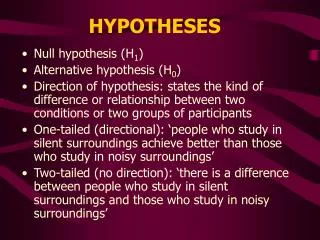
Hypothesis • A hypothesis is the basic statement that is tested in research • A hypothesis states a relationship between two variables • It is possible to use more than two variables • Because a hypothesis makes a prediction about the relationship between the two variables, it must be testable so you can determine if the prediction is right or wrong when you examine the results obtained in your study • A hypothesis must be stated in an unambiguous manner to be clearly testable
Assumptions for the example • Assume you have interest in trying to predict some phenomenon such as “attitudes toward woman’s liberation,” and that you can measure such attitudes on a continuum ranging from “opposed to woman’s liberation” to “neutral” to “supportive of woman’s liberation.” • Also assume that , lacking a theory, you will rely on “hunches” to come up with variables that might be related to attitudes toward woman’s liberation
Hypothesis Wording • You can think of hypothesis construction as a case of filling blank • “________ is related to attitudes toward woman’s liberation • You job is t think of a variable that might plausibly be related to such attitudes, and then to word a hypothesis that states a relationship between the two variable • The key is to word the hypothesis carefully so that the prediction it makes is quite clear to you as well as others
Use age as a variable • Age is related to attitudes toward woman’s liberation, with younger adults being more supportive than older adults • Age is negatively related to support for woman’s liberation(SWL) • That is, as age goes up, I predict that SWL will go down
Use Gender as a variable • Gender is nominal variable • It does not range from low to high • People are either male or female • You must be careful in stating the hypothesis unambiguously
Use Gender as a variable (Cont.) • Gender is positively related to SWL • Woman are positively related to SWL • Gender is related to SWL, with women being more supportive than men • With men being less supportive than women • Women are more likely to support woman’s liberation than are men