Understanding the Skeletal System: Functions and Bone Classifications
220 likes | 360 Views
The skeletal system serves essential functions, including support, protection, movement, storage, and red blood cell formation. The axial skeleton, comprising the cranium, vertebrae, and ribs, provides structural support, while the appendicular skeleton consists of limb bones. Vital organs like the heart and brain are protected by the skeletal frame, such as the rib cage and skull. Bones also serve as storage sites for fat and minerals. Types of bone tissue include compact and spongy, classified into long, short, flat, and irregular bones, each playing unique roles in human anatomy.


Understanding the Skeletal System: Functions and Bone Classifications
E N D
Presentation Transcript
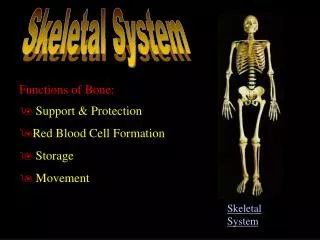
Skeletal System Functions of Bone: • Support & Protection • Red Blood Cell Formation • Storage • Movement Skeletal System
Support • Axial Skeleton: includes cranium, vertebrae & ribs - provides body’s structural core, supporting appendicular skeleton • Appendicular Skeleton - includes all limb bones
Protection • Shields that protect vital organs An example: rib cage protects • HEART • LUNGS Another example: skull protects BRAIN
Red Blood Cell Formation - Hematopoiesis • Red Marrow - cavities of spongy bone of long bones and in diploe (regions of spongy bone) of flat bones. • Over 100 million RBC’s produced every minute. RBC’s lose nuclei before leaving the marrow - survives 120 days.
Storage • Cavities of Bone - FAT storage • Bone Matrix - MINERAL storage; Ca, P, K, Na, S, Mg, Cu, released as ions into the bloodstream when needed
Movement • Muscle-operated levers • Arrangement of bone & joint design determine type of movement possible
Chemical Composition • Organic: • Cells = osteoblasts, osteocytes, osteoclasts • Matrix (35%) - collagen, fibers • Inorganic: • Mineral Salts (65%), Calcium salts - hardness of bone, durability • Resists 25,000 lb/in2 compression and 15,000 lb/in2 tension
Types of Tissue 1) Compact Bone: dense, concentric rings with canals - Haversian System - serving as conduits fornerves, blood vessels, lymphatic vessels. 2) Spongy Bone:cancellous; “little beams”; open spaces help resist stress • Classification of Bone • Long, Flat, Short, Irregular
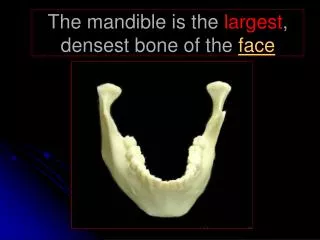
Classification of Bone examples Long Bones: all bones of limbs, except patella, wrist, ankle. Short Bones: wrist, ankle, sesamoid (patella) Irregular Bones: some skull, vertebrae, hip Flat Bones: sternum, ribs, skull
Simple fracture of the radius and ulna. Simple fracture = does not break the skin.
Compound fracture of the humerus. Compound fracture = breaks the skin and is open to infection.
Spiral fracture of the femur. Spiral fracture = a twisting motion breaks the bones at an angle.
Greenstick Fracture=incomplete break; like a green twig Common in children
Spiral What type of fracture is this?
Spiral fracture after surgery. You can see the pins that were placed through the bone.
Compound fracture of the tibia and fibula. Go to Website
What type of fracture? Simple Bone involved? Metacarpal