Understanding Physical and Chemical Properties of Matter
200 likes | 332 Views
Explore the characteristics that define matter, delving into physical and chemical properties. Learn how to identify substances through properties like density, melting and boiling points, and reactivity.


Understanding Physical and Chemical Properties of Matter
E N D
Presentation Transcript
Physical versus Chemical Properties Chapter 2 Section 2 Describing matter
Reviewing MATTER • Matter: anything that has mass and takes up space • Mass – the amount of matter in something • Volume – the amount of space something occupies • Which of the following is matter? • A car? • A box? • You?
What is a property? • Property: a characteristic of a substance that can be observed
Physical Property Physical property: a property that can be observed without changing the identity of the substance. • Examples: • luster • malleability: the ability to be hammered into a thin sheet • ductility: the ability to be stretched into a wire • melting point • boiling point • density • solubility • specific heat
Physical Properties • Color • Shape • Size • Density • Melting Point • Boiling Point
Example of Physical Property • The physical properties of sodium metal can be observed or measured. It is a soft, lustrous, silver-colored metal with a relatively low melting point and low density. • Hardness, color, melting point and density are all physical properties.
Special Physical Properties • Melting point: the temperature at which a substance changes from a solid to a liquid at a given pressure water = 0oC • Boiling point: the temperature at which a substance changes from a liquid to a gas at a given pressure water = 100oC
Thermal Density Solubility State Ductility Malleability
Chemical Properties • Chemical property: a property that can only be observed by changing the identity of the substance
Chemical Properties Examples of Chemical Properties • Reactivity with oxygen • Nonreactivity with oxygen • Flammability • Nonflammability
Density • Density is the amount of mass per unit of volume. • Density can be used to identify a substance. • The density of water is 1.0g/mL
Density Calculations • Calculations: D = m/V • Ex: A cube has a mass of 2.8 g and occupies a volume of 3.67 ml. Would this object float or sink in water? Mass = 2.8 g Volume = 3.67 mL D = 2.8g/3.67 mL= 0.76 g/mL • This object would float in water because its density is less than water (1.0 g/mL).
More Density Calculations • Ex: A liquid has a mass of 25.6 g and a volume of 31.6 mL. Use the table below to identify the substance. M=25.6 g V=31.6 mL D = 25.6 g/31.6 mL D= 0.81 g/mL The substance is ethanol.
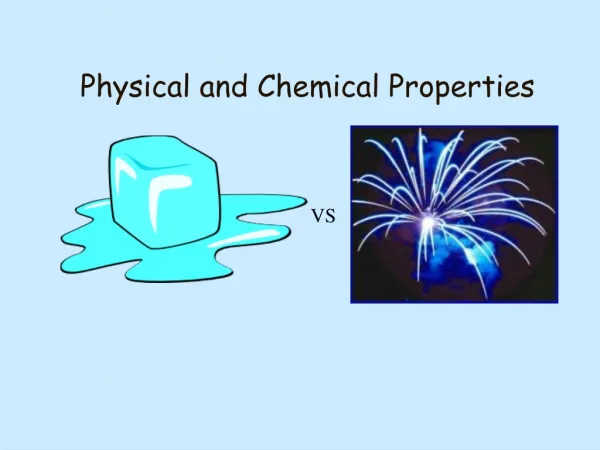
Physical Change Physical change is the change that affects one or more physical properties of a substance. • Imagine breaking a piece of chalk into two pieces. What are you changing? What is not being changed? • Physical changes do not change the identity of the matter involved
Physical Change • Freezing water for ice cubes • Sanding a piece of wood • Cutting your hair • Crushing an aluminum can • Bending a paper clip • Mixing oil and vinegar
Chemical Change Chemical change happens when two or more substance are changed into one or more new substances with different properties. • Properties of a substance describe which chemical changes will or will not happen • Chemical change and properties are not the same, a change is the process in which it changes
Chemical Change Examples of Chemical Changes • Soured milk • Effervescent tablets • Statue of Liberty • Baking a cake
Chemical Change Clues that chemical change has occurred • Changes in color • Heat • Fizzing and foaming • Production of sound or light