Understanding Dissociation of Soluble Salts: Step-by-Step Approach
This guide explores the dissociation of soluble salts in water, where salts break into positive and negative ions. These ions become mobile, enabling them to conduct electricity. The process is outlined in three steps: writing the formula, determining ion charges using provided tables, and writing the dissociation reaction. Examples include potassium fluoride (KF), calcium nitrate (Ca(NO3)2), and iron(II) sulfate (Fe(II)SO4), illustrating how to approach each dissociation systematically. Understanding this concept is crucial for studying electrolytes and ionic compounds.

Understanding Dissociation of Soluble Salts: Step-by-Step Approach
E N D
Presentation Transcript
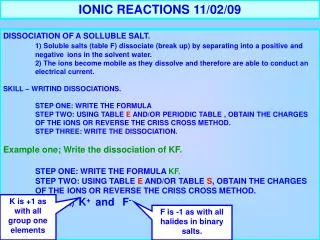
IONIC REACTIONS 11/02/09 DISSOCIATION OF A SOLLUBLE SALT. 1) Soluble salts (table F) dissociate (break up) by separating into a positive and negative ions in the solvent water. 2) The ions become mobile as they dissolve and therefore are able to conduct an electrical current. SKILL – WRITIND DISSOCIATIONS. STEP ONE: WRITE THE FORMULA STEP TWO: USING TABLE E AND/OR PERIODIC TABLE , OBTAIN THE CHARGES OF THE IONS OR REVERSE THE CRISS CROSS METHOD. STEP THREE: WRITE THE DISSOCIATION. Example one; Write the dissociation of KF. STEP ONE: WRITE THE FORMULA KF. STEP TWO: USING TABLE E AND/OR TABLE S, OBTAIN THE CHARGES OF THE IONS OR REVERSE THE CRISS CROSS METHOD. a) K+ andF- K is +1 as with all group one elements F is -1 as with all halides in binary salts.
Example one; Write the dissociation of KF. STEP ONE: WRITE THE FORMULA KF. STEP TWO: USING TABLE E AND/OR TABLE S, OBTAIN THE CHARGES OF THE IONS OR REVERSE THE CRISS CROSS METHOD. a) K+ andF- b) WRITE THE DISSOCIATION REACTION, (WITH PHASES) KF(s) K+(aq)+ F-(aq) OR YOU CAN “CROSS CRISS” ( THE SUBSCRIPT OF THE METAL BECOMES THE - CHARGE OF THE NONMETAL AND THE + CHARGE OF THE METAL. K F K+1 F-1 KF(s) K+(aq) + F-(aq)
Example one; Write the dissociation of Ca(NO3)2. STEP ONE: WRITE THE FORMULA Ca(NO3)2. STEP TWO: USING TABLE E AND/OR TABLE S, OBTAIN THE CHARGES OF THE IONS OR REVERSE THE CRISS CROSS METHOD. a) Ca+2 andNO3- b) WRITE THE DISSOCIATION REACTION, (WITH PHASES) Ca(NO3)2(s) Ca+2(aq)+ 2NO3-(aq) Table E gives the charge of EACH nitrate as -1 Ca is +2 as with all group two elements OR YOU CAN “CROSS CRISS” ( THE SUBSCRIPT OF THE METAL BECOMES THE - CHARGE OF THE NONMETAL AND THE SUNSCRIPT OF THE NONMETAL POLY-ION BECOMES THE + CHARGE OF THE METAL. Ca(NO3)2 Ca(NO3)2(s) Ca+2(aq) + 2NO3-(aq)
Example one; Write the dissociation of Fe(II)SO4. STEP ONE: WRITE THE FORMULA Fe(II)SO4. STEP TWO: USING TABLE E AND/OR TABLE S, OBTAIN THE CHARGES OF THE IONS OR REVERSE THE CRISS CROSS METHOD. a) Fe+2 andSO4-2 b) WRITE THE DISSOCIATION REACTION, (WITH PHASES) Fe(II)SO4(s) Fe+2(aq)+ SO4-2(aq) Table E gives the charge of EACH sulfate as -2 Fe is +2 as with as indicated by the Roman numeral (II) DO NOT USE THE CROSS-CRISS METHOD WITH ROMAN NUMERALS
TRY THESE NOW, WRITE DISSOCIATION K2Cr2O7 2 K+ + Cr2O72- Pb(NO3)2 Pb+2 + 2 NO3- Zn(III)(NO3)3Zn+3 + 3 NO3-