
LAB Exercise II-9 Spirometry
E N D
Presentation Transcript
Biology 211 LabExercise II-9 Spirometry Analysis of Respiratory Volumes Using the Scientific Method
What you need to know! The student be able to recognize a Spirometer The student will label and estimate lung volumes (in ml) from the graph (Graph can be found on slide 5 as well as the Lab Quiz 3 Objectives). IRV = Inspiratory Reserve Volume TV = Tidal Volume ERV = Expiratory Reserve Volume VC = Vital Capacity RV = Residual Volume TLC = Total Lung Capacity
Respiratory Volumes and Capacities – Spirometry • A person’s size, sex, age, and physical condition produce variations in respiratory volumes • Normal quite breathing moves about 500 ml of air in and out of the lungs with each breath • But a person can forcibly inhale or exhale much more air • There are terms given to the measurable respiratory volumes: Tidal volume (TV), Inspiratory reserve volume (IRV), Expiratory reserve volume (ERV), and Vital capacity (VC)
Respiratory Volumes and Capacities – Spirometry • Tidal Volume (TV): Amount of air inhaled or exhaled with each breath under resting conditions (~500ml) • Inspiratory Reserve Volume (IRV):Amount of air that can be forcefully inhaled after a normal tidal volume inhalation (~3100ml) • Expiratory Reserve Volume (ERV):Amount of air that can be forcefully exhaled after a normal tidal volume exhalation (~1200ml) • Vital Capacity (VC):Maximum amount of air that can be exhaled after a maximal inspiration (~4800ml) VC = TV + IRV + ERV
Respiratory Volumes and Capacities – Spirometry • An idealized tracing of the various respiratory volumes and their relationships to each other are shown in your Lab Quiz 3 Objectives (page 18) A B C D E F
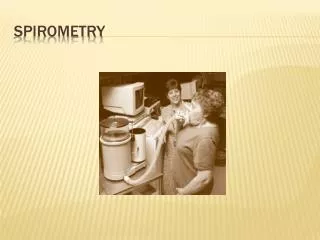
Respiratory Volumes and Capacities – Spirometry • Respiratory volumes will be measured with an apparatus called a spirometer • Read Exercise II-9 • Work in pairs, with one person acting as the subject while the other records the data of the column determinations • The subject should stand erect during testing • Reset the indicator to 0 before beginning each trial
Respiratory Volumes and Capacities – Spirometry • Obtain a disposable mouthpiece • Insert it in the open end of the valve assembly of the wet spirometer • Before beginning, the subject should practice exhaling through the mouthpiece without exhaling through the nose • Conduct the test 3 times for each required measurement, record your data, and find the average (pg 92)
Respiratory Volumes and Capacities – Spirometry • Tidal Volume (TV) – the volume of air inhaled and exhaled with each normal breath is approximately 500ml • To conduct this test, inhale a normal breath, and then exhale a normal breath of air into the spirometer mouthpiece (Do not force expiration!) • Record the volume and repeat twice • Expiratory Reserve Volume (ERV) – the volume of air that can be forcibly exhaled after a normal expiration ranges between 1000 and 1200ml • Inhale and exhale normally 2 to 3 times, then insert the spirometer mouthpiece and exhale forcibly as much of the additional air as you can • Record the volume and repeat twice • Inspiratory Reserve Volume (IRV) + Tidal Volume (TV) • IRV - the volume of air that can forcibly inhaled following a normal inspiration • Inhale and exhale normally 2 to 3 times, then inhale as deeply as possible and then insert the spirometer mouthpiece and exhale normally • Record the volume and repeat twice
Respiratory Volumes and Capacities – Spirometry • Inspiratory Reserve Volume (IRV) - the volume of air that can forcibly inhaled following a normal inspiration • IRV is obtained after subtracting the TV from the recorded IRV + TV values • Vital Capactiy (VC) – the total exchangeable air of the lungs (the sum of TV + IRV + ERV) is normally around 4500ml with a range of 3600-4800ml • Breath in and our normally 2 or 3 times, and then bend over and exhale all the air possible • Then as you raise yourself to the upright position, inhale as fully as possible • Quickly insert the mouthpiece, and exhale as forcibly as you can • Record your result and repeat twice
Scientific Method • Spirometry: Spirometry is the measure of volume changes in the lungs during breathing. It can be used to assess whether lungs are normal or dysfunctional.
What you need to know: Scientific Method • The student will also understand the scientific method as it was demonstrated with the spirometer. The student will define and give the importance of: • hypothesis • control group • experimental group • appropriate conclusions • sample size • experimental error
Scientific Method pages 93-94 • Hypothesis- development of a question to be answered in the form of a hypothesis. The hypothesis is an unproven conclusion that you test in an experiment. • Spirometry and maximal respiratory pressures are pulmonary functionparameters commonly used to evaluate respiratory function. Based on this information my hypothesis could be: Chronic obstructive pulmonary disease can be detected by measuring lung volumes with spirometry. • Your hypothesis can be whatever you want to prove…Another example could be: Female runners age 20-30 have a larger respiratory capacity than female non-runners of the same age. • Control group - Control groups are not manipulated. They are the foundational point for which to compare the experimental group against • For my experiment I am trying to prove that COPD can be detected by spirometry. So my control group would be normal healthy adults void of any respiratory condition. Ultimately they would be of similar age, sex, and overall health as my experimental group.
Scientific Method pages 93-94 • Experimental group - The group being treated, or otherwise manipulated for the sake of the experiment. This group is identical to the control group EXCEPT that it is manipulated • For my experimental group I would test people who knowingly have COPD. I would be able to compare their spirometry results to those of my control group. Hopefully their would be a statistically significant difference. • Appropriate conclusions - You check to see if your data supports your hypothesis. If the data does, you can say the hypothesis is supported, but not proven. If the experiment is repeated multiple times by many different scientists yielding the same results then it will become a theory. Once a theory is tested multiple times by many different scientists all still yielding the same results than it may become a scientific law • Sample size - In most experiments it is rarely possible to take measurements from every individual in the population either in a laboratory situation or in the field. A sub set or sample is used to estimate the values that might have been obtained had we measured every individual in the population. A sample is made up of a series of sampling units, sampling should allow sufficiently reliable information about the particular population under investigation. • For our in class work the sample size would be the number of students tested
Scientific Method pages 93-94 • Experimental error -This may be due to inherent limitations in the measuring equipment, or of the measuring techniques, or perhaps the experience and skill of the experimenter. However, mistakes do not count as part of the analysis. This is looking for errors with the experiment. If you make a personal mistake you must correct the mistake and re run the experiment. As a “new” experimenter human error will be present but it is reduced by practice