Download

1 / 9
0 likes | 2 Views
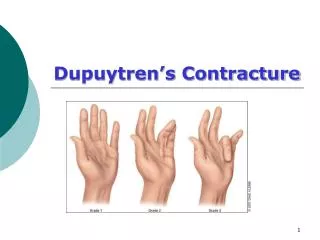
Dupuytrenu2019s Contracture can make everyday tasksu2014like shaking hands, gripping a steering wheel, or holding a coffee mugu2014feel difficult and frustrating. As the tissue in the palm thickens and tightens, one or more fingers begin to bend towards the palm and cannot fully straighten.<br>Because surgery can be expensive, invasive, and require long recovery times, many people start by asking: are there any effective home remedies for Dupuytren's Contracture?<br>In this guide, we will explore the most commonly discussed home remedies for Dupuytrenu2019s Contracture, what they can and cannot do,

E N D
Home Remedies for Dupuytren's Contracture: What Really Helps at Home? Dupuytren’s Contracture can make everyday tasks—like shaking hands, gripping a steering wheel, or holding a coffee mug—feel difficult and frustrating. As the tissue in the palm thickens and tightens, one or more fingers begin to bend towards the palm and cannot fully straighten. Because surgery can be expensive, invasive, and require long recovery times, many people start by asking: are there any effective home remedies for Dupuytren's Contracture? In this guide, we will explore the most commonly discussed home remedies for Dupuytren’s Contracture, what they can and cannot do, and how non-surgical options like the Dupuytren’s Wand and Tape can support your hands more effectively from the comfort of your home. Can Home Remedies Cure Dupuytren’s Contracture? It is important to understand that no simple home remedy can “cure” Dupuytren’s Contracture overnight. The condition involves thickening and contracting of the connective tissue in the palm, which tends to progress over time. However, in the early stages, certain home remedies for Dupuytren’s Contracture may help: • Reduce discomfort and stiffness • Support better flexibility
• Slow down the feeling of tightness in the palm and fingers • Complement non-surgical treatments you use at home For more advanced or rapidly progressing cases, you should always consult a healthcare professional. Home care is most effective when started early and used consistently. Common Home Remedies for Dupuytren’s Contracture Below are some of the most frequently used home remedies for Dupuytren's Contracture. While results vary from person to person, many people use these methods to support general comfort and hand mobility. 1. Gentle Stretching and Finger Exercises Gentle stretching is often recommended to help maintain range of motion. Some examples include: • Finger spreads: Place your hand flat on a table and slowly spread your fingers apart, then relax. • Finger lifts: With your palm flat, gently lift one finger at a time off the table, hold for a few seconds, and release. • Passive extension: Use your other hand to gently straighten the bent finger as far as is comfortable—without forcing it. These exercises should be slow, controlled, and pain-free. Over-stretching or forcing the finger straight can worsen discomfort. 2. Warm Compresses Applying gentle heat to the palm may help to: • Relax the soft tissues • Ease stiffness • Make stretching and massage more comfortable A simple home remedy is to use a warm (not hot) towel or heating pad for 10–15 minutes before doing any stretching or exercises. Always test the temperature on another part of your skin first to avoid burns. 3. Hand Massage Light massage around the palm and fingers can: • Increase local blood flow • Reduce feelings of tightness • Help you stay aware of early nodules or cords
You can use a small amount of lotion or oil and make slow circular motions along the palm, avoiding excessive pressure on painful nodules. Massage alone will not stop the condition, but it can be a supportive home remedy for Dupuytren’s Contracture symptoms. 4. Lifestyle Support: Managing Risk Factors While there is no guaranteed way to prevent Dupuytren’s Contracture, some lifestyle choices may support overall hand and tissue health: • Avoid smoking, as it may affect circulation. • Manage conditions like diabetes under medical guidance. • Keep an eye on repetitive strain or gripping activities that Home Remedies for Dupuytren's Contracture: What Really Helps at Home? • Dupuytren’s Contracture can make everyday tasks—like shaking hands, gripping a steering wheel, or holding a coffee mug—feel difficult and frustrating. As the tissue in the palm thickens and tightens, one or more fingers begin to bend towards the palm and cannot fully straighten. • Because surgery can be expensive, invasive, and require long recovery times, many people start by asking: are there any effective home remedies for Dupuytren's Contracture? • In this guide, we will explore the most commonly discussed home remedies for Dupuytren’s Contracture, what they can and cannot do, and how non-surgical options like the Dupuytren’s Wand and Tape can support your hands more effectively from the comfort of your home. • • Can Home Remedies Cure Dupuytren’s Contracture? • It is important to understand that no simple home remedy can “cure” Dupuytren’s Contracture overnight. The condition involves thickening and contracting of the connective tissue in the palm, which tends to progress over time. • However, in the early stages, certain home remedies for Dupuytren’s Contracture may help: • Reduce discomfort and stiffness • Support better flexibility • Slow down the feeling of tightness in the palm and fingers • Complement non-surgical treatments you use at home • For more advanced or rapidly progressing cases, you should always consult a healthcare professional. Home care is most effective when started early and used consistently. • • Common Home Remedies for Dupuytren’s Contracture • Below are some of the most frequently used home remedies for Dupuytren's Contracture. While results vary from person to person, many people use these methods to support general comfort and hand mobility.
• 1. Gentle Stretching and Finger Exercises • Gentle stretching is often recommended to help maintain range of motion. • Some examples include: • Finger spreads: Place your hand flat on a table and slowly spread your fingers apart, then relax. • Finger lifts: With your palm flat, gently lift one finger at a time off the table, hold for a few seconds, and release. • Passive extension: Use your other hand to gently straighten the bent finger as far as is comfortable—without forcing it. • These exercises should be slow, controlled, and pain-free. Over-stretching or forcing the finger straight can worsen discomfort. • 2. Warm Compresses • Applying gentle heat to the palm may help to: • Relax the soft tissues • Ease stiffness • Make stretching and massage more comfortable • A simple home remedy is to use a warm (not hot) towel or heating pad for 10–15 minutes before doing any stretching or exercises. Always test the temperature on another part of your skin first to avoid burns. • 3. Hand Massage • Light massage around the palm and fingers can: • Increase local blood flow • Reduce feelings of tightness • Help you stay aware of early nodules or cords • You can use a small amount of lotion or oil and make slow circular motions along the palm, avoiding excessive pressure on painful nodules. Massage alone will not stop the condition, but it can be a supportive home remedy for Dupuytren’s Contracture symptoms. • 4. Lifestyle Support: Managing Risk Factors • While there is no guaranteed way to prevent Dupuytren’s Contracture, some lifestyle choices may support overall hand and tissue health: • Avoid smoking, as it may affect circulation. • Manage conditions like diabetes under medical guidance. • Keep an eye on repetitive strain or gripping activities that aggravate your symptoms.
• These are general health measures, but they can complement other home remedies for Dupuytren’s Contracture and professional treatments. • • Where Traditional Home Remedies Fall Short • Traditional home remedies—heat, stretching, massage—may offer comfort, but they are often: • Inconsistent (hard to apply the same way each time) • Not targeted deeply enough into the tissue • Easy to forget or difficult to do correctly every day • Because Dupuytren’s affects the deeper connective tissues in the palm, a morefocused, technology-assisted home treatment can be more effective than basic household methods alone. • That is where the Dupuytren’s Wand and Tape offer a more structured at-home approach. • • A Modern, Non-Surgical Home Treatment: Dupuytren’s Wand & Tape • If you are looking for home remedies for Dupuytren’s Contracture that go beyond simple heat or massage, the Dupuytren’s Wand and Tape are designed specifically for this condition and can be used safely at home. • How the Dupuytren’s Wand Works • The Dupuytren’s Wand is an easy-to-use device developed to provide a targeted, non-surgical approach: • It uses far infrared and ultrasound technology. • It feels like gentle warmth, even though it is working deeper in the tissues. • You simply move the wand in slow, circular motions over the affected area. • A typical home session lasts around 10–15 minutes, and consistent use is essential for best results. • Step-by-Step: Using the Wand at Home • Preparation • Wash and dry your hands. • Sit comfortably so you can relax your affected hand. • Application • Turn on the Dupuytren’s Wand and allow it to warm up for a few seconds. • Apply it to the palm and areas where you notice nodules or cords. • Move it slowly in circular motions across the area.
• Duration • Continue for about 10–15 minutes per session. • Use regularly according to the recommended instructions. • Aftercare • Gently stretch and extend your fingers to maintain flexibility. • Apply a light lotion if your skin feels dry. • This process combines the benefits of controlled heat, deep tissue stimulation, and massage—all in one focused home treatment. • • Supporting Results with Dupuytren’s Tape • Alongside the Wand, Dupuytren’s Tape can help: • Support the fingers in a more extended position • Gently counter the pull of contracting tissue • Encourage better alignment after each session • Using the Wand first, then applying Dupuytren’s Tape as directed, creates a complete at-home management routine: relief, mobility support, and gentle positioning. • • Are Home Remedies Enough, or Should You See a Doctor? • While home remedies for Dupuytren’s Contracture and non-surgical tools like the Dupuytren’s Wand and Tape can be very helpful—especially in early stages—you should consider talking to a doctor if: • Your fingers are bending more and more into the palm • You cannot place your hand flat on a table • You feel significant pain or rapid changes • Daily tasks like driving, writing, or gripping objects are becoming difficult • A healthcare professional can confirm your diagnosis, discuss progression, and help you combine home treatment with medical advice where needed. • • The Bottom Line: Smarter Home Care for Dupuytren’s Contracture • There are many home remedies for Dupuytren’s Contracture—from stretching and warm compresses to massage and lifestyle adjustments. While these can provide some relief and support, they are often limited in how deeply and consistently they work on the affected tissue.
• For people looking for a more structured, practical alternative to surgery, the Dupuytren’s Wand and Tape offer: • Non-invasive, at-home use • Targeted support for nodules, cords, and contractures • A simple routine you can build into your daily life • By combining smart, modern tools with gentle stretches and mindful self-care, you can take active steps at home to: • Reduce discomfort • Support hand flexibility • Regain more control over your daily activities • If you are ready to begin a more focused home treatment plan, explore how the Dupuytren’s Wand and Tape can fit into your personal approach to managing Dupuytren’s Contracture. • Where Traditional Home Remedies Fall Short Traditional home remedies—heat, stretching, massage—may offer comfort, but they are often: • Inconsistent (hard to apply the same way each time) • Not targeted deeply enough into the tissue • Easy to forget or difficult to do correctly every day Because Dupuytren’s affects the deeper connective tissues in the palm, a more focused, technology-assisted home treatment can be more effective than basic household methods alone. That is where the Dupuytren’s Wand and Tape offer a more structured at-home approach. A Modern, Non-Surgical Home Treatment: Dupuytren’s Wand & Tape If you are looking for home remedies for Dupuytren’s Contracture that go beyond simple heat or massage, the Dupuytren’s Wand and Tape are designed specifically for this condition and can be used safely at home. How the Dupuytren’s Wand Works The Dupuytren’s Wand is an easy-to-use device developed to provide a targeted, non-surgical approach: • It uses far infrared and ultrasound technology. • It feels like gentle warmth, even though it is working deeper in the tissues. • You simply move the wand in slow, circular motions over the affected area. A typical home session lasts around 10–15 minutes, and consistent use is essential for best results. Step-by-Step: Using the Wand at Home
1.Preparation • Wash and dry your hands. • Sit comfortably so you can relax your affected hand. 2.Application • Turn on the Dupuytren’s Wand and allow it to warm up for a few seconds. • Apply it to the palm and areas where you notice nodules or cords. • Move it slowly in circular motions across the area. 3.Duration • Continue for about 10–15 minutes per session. • Use regularly according to the recommended instructions. 4.Aftercare • Gently stretch and extend your fingers to maintain flexibility. • Apply a light lotion if your skin feels dry. This process combines the benefits of controlled heat, deep tissue stimulation, and massage—all in one focused home treatment. Supporting Results with Dupuytren’s Tape Alongside the Wand, Dupuytren’s Tape can help: • Support the fingers in a more extended position • Gently counter the pull of contracting tissue • Encourage better alignment after each session Using the Wand first, then applying Dupuytren’s Tape as directed, creates acomplete at-home management routine: relief, mobility support, and gentle positioning. Are Home Remedies Enough, or Should You See a Doctor? While home remedies for Dupuytren’s Contracture and non-surgical tools like the Dupuytren’s Wand and Tape can be very helpful—especially in early stages—you should consider talking to a doctor if: • Your fingers are bending more and more into the palm • You cannot place your hand flat on a table • You feel significant pain or rapid changes • Daily tasks like driving, writing, or gripping objects are becoming difficult
A healthcare professional can confirm your diagnosis, discuss progression, and help you combine home treatment with medical advice where needed. The Bottom Line: Smarter Home Care for Dupuytren’s Contracture There are many home remedies for Dupuytren’s Contracture—from stretching and warm compresses to massage and lifestyle adjustments. While these can provide some relief and support, they are often limited in how deeply and consistently they work on the affected tissue. For people looking for a more structured, practical alternative to surgery, the Dupuytren’s Wand and Tape offer: • Non-invasive, at-home use • Targeted support for nodules, cords, and contractures • A simple routine you can build into your daily life By combining smart, modern tools with gentle stretches and mindful self-care, you can take active steps at home to: • Reduce discomfort • Support hand flexibility • Regain more control over your daily activities If you are ready to begin a more focused home treatment plan, explore how the Dupuytren’s Wand and Tapecan fit into your personal approach to managing Dupuytren’s Contracture.